
FRIANT Emile
Émile Friant (1863-1932), a leading naturalist painter of the École de Nancy, was also a virtuoso draughtsman and printmaker. Galerie 125 offers a fine selection of his original drawings, engravings and lithographs, featuring portraits and scenes of Lorraine, which you can discover below.




Émile Friant
Lorraine naturalism through the pencil
A painter, draughtsman and printmaker from Lorraine, Émile Friant (1863-1932) is one of the leading figures of the École de Nancy and of French naturalism. His scenes of everyday life, his portraits and his large compositions, marked by an almost photographic precision and a deep humanity, rank among the masterpieces of late nineteenth-century painting. His drawings, etchings and lithographs carry the same keenness of vision.
Biographical milestones
1863Born on 16 April in Dieuze, Moselle
1871After the annexation, his family settles in Nancy
1883Second Grand Prix de Rome
1889Gold medal at the Exposition Universelle for La Toussaint
1901Founding member of the École de Nancy
1923Elected to the Académie des Beaux-Arts
1932Dies in Nancy on 9 June
The career of Émile Friant
A child of Moselle who became a Nancy artist
Born in Dieuze, Moselle, Émile Friant left his birthplace with his family after the annexation of 1871 and settled in Nancy. A brilliant student at the Nancy School of Fine Arts, he then went to Paris to work in the studio of Alexandre Cabanel. In 1883 he won the second Grand Prix de Rome. He formed a deep friendship with the actor Constant Coquelin and with Victor Prouvé, another great artist from Nancy.
Naturalism and everyday life
Friant painted the life of his time with striking accuracy: La Toussaint, Les Amoureux, Ombres portées, Les Lutteurs and La Douleur show simple scenes, intimate emotions and figures captured in their truth. He used photography to prepare his paintings, which gives his works a remarkable precision, always in the service of emotion. He was also a sought-after portraitist of Lorraine society.
The École de Nancy
In 1901, Friant took part in founding the École de Nancy, the alliance of the provincial decorative arts industries, alongside Émile Gallé, Louis Majorelle, Victor Prouvé and the Daum brothers. As a teacher, he trained many young artists from Lorraine. Elected to the Académie des Beaux-Arts in 1923, he remained attached to Nancy, where he died in 1932. The Musée des Beaux-Arts de Nancy and the musée d'Orsay hold his masterpieces.
The printmaker and the draughtsman
Émile Friant was also a printmaker and draughtsman of great talent. His etchings, drypoints and drawings, often devoted to portraits and intimate scenes, show the same keenness of vision as his paintings. They are much appreciated by collectors from Lorraine and by enthusiasts of the Belle Époque.
Prices and market value of Émile Friant: how much is a work worth?
The price of a work by Émile Friant depends on its technique, subject, format and provenance. Portraits and scenes of Nancy life are the most sought after. As a guide, here are the ranges generally seen on the market, both in galleries and at auctions:
- Lithographs: approximately €200 to €500 depending on the edition size and subject.
- Original engravings: around €500, more for fine impressions.
- Original drawings in pencil, charcoal or red chalk (sanguine): approximately €1,250 to €3,000 for studies and portraits.
- Large finished drawings: approximately €10,000 to €15,000.
- Oil on canvas: much higher prices, reserved for major auctions.
An original lithograph is printed by the artist or under his supervision. A simple printed reproduction does not have the same value: the gallery describes each print precisely.
Buy a work by Émile Friant
Looking for a Friant lithograph, an engraving or an original drawing? The gallery presents below a fine selection, from portraits to scenes of Lorraine life:
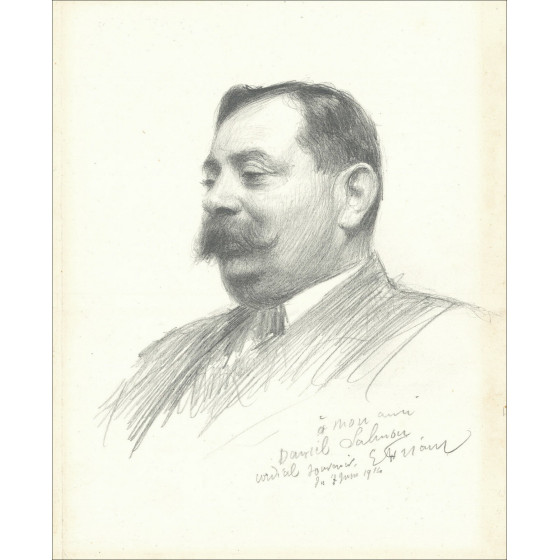
- Drawings: Portrait (1914), Portrait de jeune femme (1926), Études d'enfants, Étude pour le vieux cheval (1902) and the large Portrait de femme jouant de la harpe.
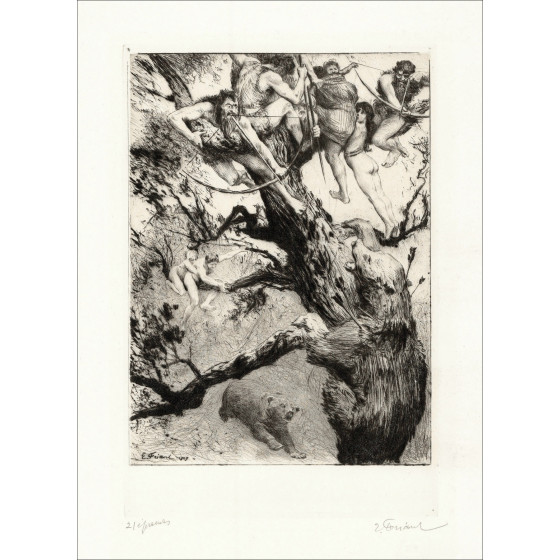
- Engravings: Les ancêtres (1909) and Mandoliniste de profil (1929).
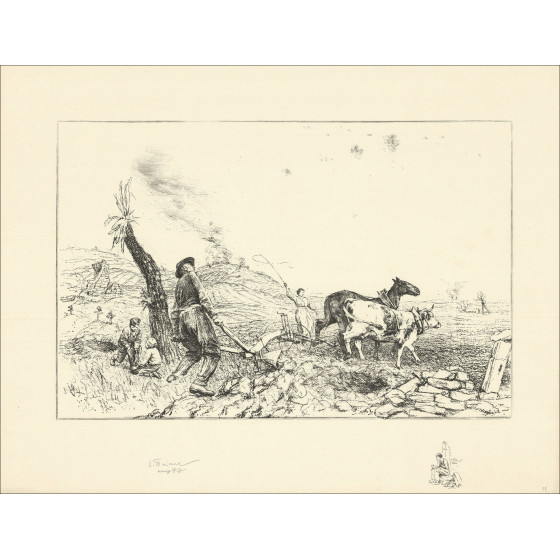
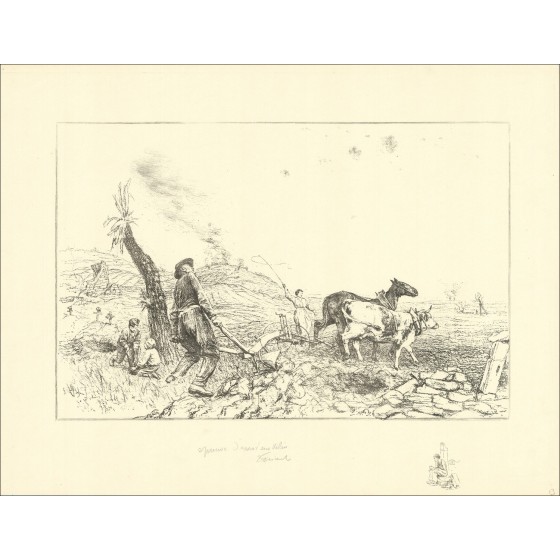
- Lithographs: Portrait de Léon Levy, Menu anciens élèves, Les frères Zenigano à Goncourt, Bal des courtisanes or Travaux des champs.
Some pieces have already found a new owner: check the page regularly to follow new acquisitions. Each work offered by the gallery is described in detail and sold with a certificate invoice. It can be ordered online, with careful, tracked and insured shipping, or viewed by appointment at our art gallery near Metz, an hour from Nancy. Also worth discovering: Camille Hilaire, Jean Lurçat and André Jacquemin, other artists from Lorraine.
How much does a lithograph or drawing by Émile Friant cost?
Works available at the gallery range from €200 to €14,500. Lithographs start at €200, engravings around €500 and drawings from approximately €1,250.
Did Émile Friant make lithographs?
Yes. He produced commissioned lithographs: portraits of Nancy lawyers, menus for alumni dinners, compositions for a pharmacy, or scenes inspired by the emerging aviation, such as the one from Jarville-la-Malgrange in 1909.
What subjects do his engravings depict?
His etchings mainly show intimate figures: a grandmother, a mandolin player, a man holding a glass. Some exist in several states, which helps date them and adds to their interest for collectors.
Why are his drawings so sought after?
Friant drew to prepare his paintings: studies of children, horses or figures. These sheets, in pencil, red chalk or chalk, reveal his method and his mastery of line.
Where can you see Émile Friant's paintings?
The Musée des Beaux-Arts de Nancy and the musée d'Orsay hold his masterpieces, including La Toussaint, awarded a gold medal at the 1889 Exposition universelle.
Who were his fellow artists of the École de Nancy?
Founded in 1901, the École de Nancy brought together Émile Gallé, Louis Majorelle, Victor Prouvé and the Daum brothers around a modern Lorraine art combining decorative arts and fine arts.
Do you own an oil on canvas, a watercolour or an original drawing by Émile Friant and wish to sell it? Discover how to proceed on our Sell a work page.