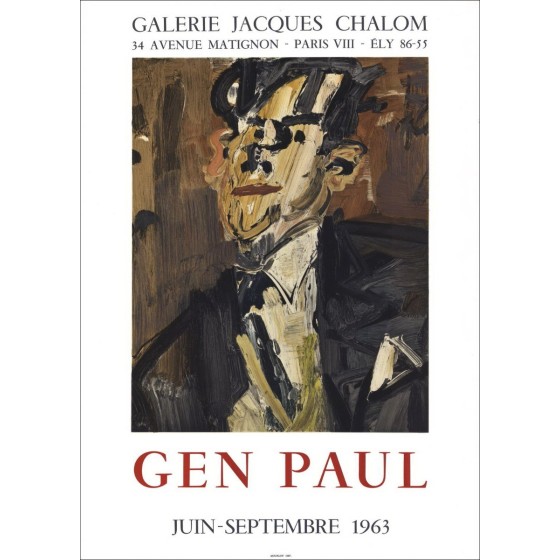
GEN PAUL (dit PAUL Eugène)
Eugène PAUL, known as GEN PAUL, was a French expressionist painter born in Paris (XVIII) on July 2, 1895, and died in Paris (XIII) on April 30, 1975. This self-taught artist, often referred to as the "painter of Montmartre," was a draftsman, gouache painter, engraver, and lithographer. A friend of Louis-Ferdinand Céline, Gen Paul was introduced to the technique of engraving by Eugène Delâtre. It is worth noting that Eugène PAUL painted under the pseudonym Paul Trelade, his first canvases between 1919 and 1924.
Biography of GEN PAUL
Eugene PAUL, says GEN PAUL, was a French expressionist painter born in Paris (XVIII) on 2 July 1895 and died in Paris (XIII) on 30 April 1975. This self-taught artist, often referred to as "painter of Montmartre", was a cartoonist, gouachist, engraver and lithographer. A friend of Louis-Ferdinand Céline, Gen Paul was introduced to the technique of engraving by Eugène Delâtre. Eugène PAUL painted under the pseudonym of Paul Trelade, his first paintings between 1919 and 1924.
History of Eugene PAUL, says GEN PAUL
Eugène Paul was born in a house at 96 Lepic Street in Montmartre, where many illustrious artists passed. He practised painting and drawing from a young age. His mother worked as an embroiderer and his father, a cabaret musician, died when he was only 10.
Gen Paul learns the carpenter trade to build decorative furniture.
Under Parisian patriotic pressure, he was forced to engage when the First World War broke out. A serious injury having seriously affected him, he loses a leg. Restored from the amputation and his eighteen months of mobilization and combat, he returned to painting and became a friend, at the Bateau-Lavoir, of Juan Gris, who would help him a lot.
He was appointed on October 20, 1934, knight of the Legion of Honour
At the end of the Second World War, he escaped the purification, for Gen Paul was during the war near Otto Abetz, collaborationist and anti-Semitic circles.
His first works were influenced by the paintings of his friends from Montmartre: Frank-Will, Maurice de Vlaminck and Maurice Utrillo.
However, he quickly developed an expressionist personality reflecting various influences such as Toulouse-Lautrec, Vincent van Gogh, Paul Cézanne, Goya, Diego Velázquez, El Greco.
Influences found at that time with his friend Henri-Martin Lamotte. The cubist influences of Juan Gris, Pablo Picasso and Fernand Léger are found in some of these works, so his engravings of urban landscapes are much more "realistic".
Between 1925 and 1929, in the inter-war period, while Gen Paul, he produced several of his best-known paintings, seeking to overcome his physical handicap and the memory of war, and of these horrors. They are characterized by the movement created by the brush gesture, the boldness of compositions imprinted with forced views, diagonal, zebras and zigzags, juxtaposing abstract coloured motifs to realistic parts.
Unlike Chaim Soutine and Georges Rouault, other expressionists of that time, and contrary to German expressionists, darker, who already seem to announce World War II, Gen Paul's works are the expression of the simplicity of daily life, they are optimistic, living, colorful, cheerful.
Through the dynamism and movement present in his paintings, some consider Gen Paul as the precursor of the forms of abstract expressionism of the 1950s.
Gen Paul died in Paris on 30 April 1975 at the Hospital of Pitié-Salpêtrière.
Buy a work of GEN PAUL
Our art gallery in Metz offers a wide selection of works and paintings by artist Gen Paul. Discover some of the artist's drawings, lithographs and engravings on our website.