
JENKINS Paul
Paul Jenkins (1923-2012), American painter based between Paris and New York, set colour flowing in translucent veils of rare luminosity. Exhibition posters and lithographs printed in Paris extend these flows of light.
Paul Jenkins
Colour poured like light
American painter and writer Paul Jenkins (1923-2012) is among the major figures of post-war abstraction. Between New York and Paris, he invented a unique way of painting: pouring colour onto the canvas and guiding its flows by tilting the stretcher, until he obtained translucent veils of exceptional intensity.
Paul Jenkins, from Kansas City to Paris
Born on 12 July 1923 in Kansas City, Missouri, Paul Jenkins grew up in Ohio. After the war, during which he served in the naval air corps, he studied from 1948 to 1952 at the Art Students League in New York, where he mixed with the Abstract Expressionist artists, including Jackson Pollock, Mark Rothko and Lee Krasner. Goethe, Jung and Eastern spiritual traditions fed his reflections on colour and light.
In 1953, he settled in Paris, where he frequented Jean Dubuffet, Henri Michaux and the painters of lyrical abstraction. His first solo exhibition took place in 1954 at the Studio Paul Facchetti. The Martha Jackson gallery championed him in New York. His work was subsequently shown around the world, notably at the Whitney Museum, the Guggenheim and the Musée national d'art moderne in Paris. He died in New York on 9 June 2012.
Phenomena: poured painting, transparencies and lithography
From 1960 onwards, Jenkins titled almost all his works "Phenomena", followed by a poetic subtitle, as if to say that painting is an apparition of light and energy. Liquid colour is poured onto the primed canvas, then directed with an ivory knife. Large transparent layers then overlap like prisms. The critic Jean Cassou saw him as an artist of the informel rather than an Abstract Expressionist.
As a writer, he also published texts about his art. Cinema called on him: he painted the pictures for the film "Une femme libre" (1978). Lithography and watercolour naturally extend his work, as they lend themselves particularly well to his transparencies. His exhibition posters, printed by the Mourlot workshop in Paris, attest to his presence on the Parisian scene.
Paul Jenkins at Galerie 125
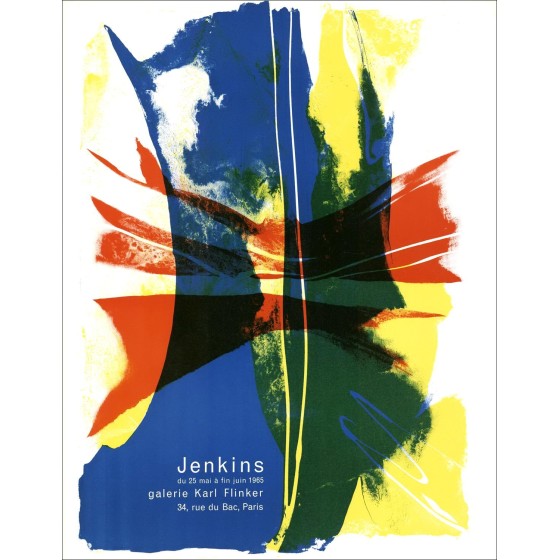
The gallery has presented above the lithograph Exposition, Galerie Karl Flinker, Paris (1965, 70 x 54 cm), printed by Mourlot on the occasion of the artist's Parisian exhibition. It is now sold: other pieces will join the page as acquisitions are made, so check back regularly and order online as soon as a work is available, with a certificate from the gallery and careful, tracked and insured delivery.
An art gallery near Metz, between Metz, Thionville and Luxembourg, Galerie 125 welcomes you in Argancy by appointment. Lovers of abstraction, also discover Hans Hartung, Georges Mathieu and Olivier Debré.
Who were Paul Jenkins's friends in Paris?
He frequented Jean Dubuffet, Henri Michaux and the painters of lyrical abstraction, and exhibited as early as 1954 at the Studio Paul Facchetti.
Why are so many works titled "Phenomena"?
From 1960 onwards, this title expressed his conception of painting as a natural phenomenon, an apparition of light and energy.
Where can I find his lithographs and posters?
The Galerie 125 page presents his posters and lithographs as they are acquired, with online ordering.