
PAPART Max


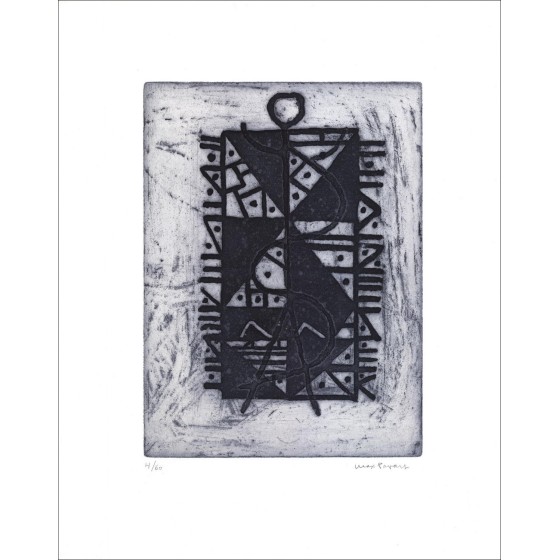

Max PAPART, born in Marseille (France) in 1911 and died in 1994, is a Franco-American contemporary painter-collier. His work is marked by a certain softness of life, a discreet irony (quasi-non-existent) and a great sense of plastic beauty. As a young man, Max PAPART briefly attended the École des beaux-arts in Marseille, preferring to form himself in painting. He settled in Paris in 1936 and worked as a printmaker. He exhibited at the Salon des Indépendants and made his first prints. His first personal exhibition took place at the Galerie Bureau in Paris in 1938. Max Papart participated in the liberation of Marseilles. He then exhibited at the Galerie Sébire in Marseilles in 1946. He illustrated books by Jacques Prévert and Georges Ribemont-Dessaugnes. It evolves from a post-cubist language to an expression that borrows from abstraction certain plastic reasonings. Lithograph, engraver, painter, he often uses mixed techniques and collage. In 1970, he completed his technique of etching with the help of carborundum according to the technique invented in 1968 by his friend Henri Goetz. He taught printing at the University of Paris VIII in Vincennes from 1969 to 1973.