
RENOIR Auguste
Auguste Renoir (1841-1919), a leading figure of Impressionism and the creator of Bal du moulin de la Galette and Jeunes filles au piano. Discover below lithographs after his paintings and lithographed exhibition posters from the 1960s, available to buy online.


Auguste Renoir
The Painter of Happiness
Auguste Renoir (1841-1919) is one of the most beloved painters in the world. A central figure of Impressionism, he painted the joy of living: balls, boaters, children, women and flowers, in vibrant light and shimmering colour. A painter, but also an engraver, lithographer and sculptor, he left an immense body of work, estimated at some four thousand paintings.
Biographical Milestones
1841Born in Limoges on 25 February. Childhood in Paris
1854Apprentice porcelain painter
1862Studio of Gleyre, with Monet, Sisley and Bazille
1874Takes part in the first Impressionist exhibition
1876Bal du moulin de la Galette
1881Le Déjeuner des canotiers, followed by a trip to Italy
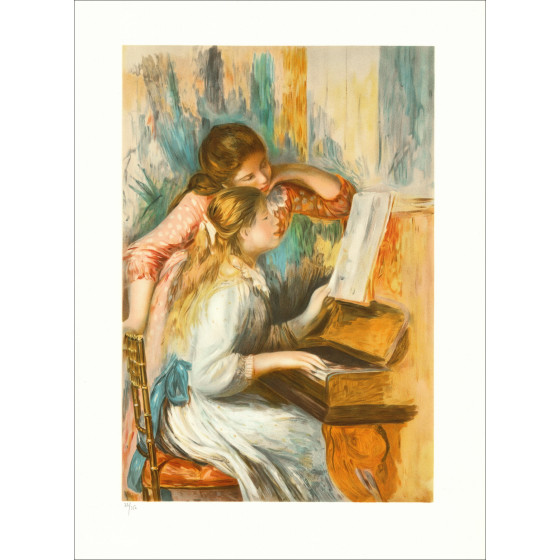
1892Jeunes filles au piano, acquired by the State
1907Settles at the Domaine des Collettes, in Cagnes-sur-Mer
1919Dies in Cagnes-sur-Mer, on 3 December
Renoir's Career
From Porcelain to Impressionism
Born in Limoges into a modest family, Pierre-Auguste Renoir grew up in Paris and began as a porcelain painter. He copied the masters at the Louvre, then entered the studio of Charles Gleyre, where he befriended Claude Monet, Alfred Sisley and Frédéric Bazille. Painting side by side with Monet at La Grenouillère, he developed with him a fragmented brushstroke that captured the reflections of water and light. In 1874, he took part in the first Impressionist exhibition.
The Painter of Joie de Vivre
Bal du moulin de la Galette (1876) and Le Déjeuner des canotiers (1881) are among the most famous images in French art: Paris amuses itself, dances and gathers by the water's edge. After a trip to Italy, Renoir went through a more classical period, known as his "dry" phase, under the influence of Raphael, before returning to a supple, pearly brushstroke. His Jeunes filles au piano, acquired by the State in 1892, marked his official recognition.
The Final Years at Cagnes
Suffering from polyarthritis, Renoir settled in the South of France, at the Domaine des Collettes in Cagnes-sur-Mer, now a museum. Despite the illness, he continued painting until the end, producing dazzling nudes, bathers and landscapes, and made sculptures with the help of the young Richard Guino. He was the father of filmmaker Jean Renoir.
Renoir and Printmaking
Renoir practised etching and lithography, notably for the publisher Ambroise Vollard. His paintings were later widely disseminated through lithographs after his works and through posters for major exhibitions, carefully printed in lithography, which convey the softness of his palette.
Renoir Prices and Market Value: How Much Is a Work Worth?
Renoir is one of the Impressionists most widely represented on the market, from reproductions after his paintings to major museum-quality canvases. The price depends on the status of the work (original or reproduction), then on the technique, the subject, the edition and the condition. Here are the ranges generally observed on the market, both in galleries and at auctions:
- Exhibition posters and lithographs after his paintings: approximately €85 to €195.
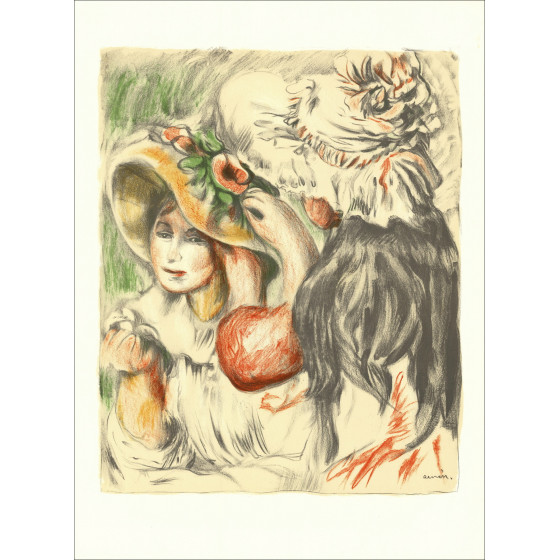
- Original lithographs and etchings, such as Le Chapeau épinglé: from a few thousand to several tens of thousands of euros.
- Bronze sculptures made with Richard Guino: from several tens to several hundreds of thousands of euros.
- Drawings, pastels and red chalk works: from several tens to several hundreds of thousands of euros.
- Paintings: from several hundreds of thousands of euros to several tens of millions.
Portraits of young women and children, nudes, flowers and outdoor scenes are the most sought-after subjects. When it comes to prints, it is essential to distinguish original impressions from reproductions after his paintings.
Buying a work by Renoir
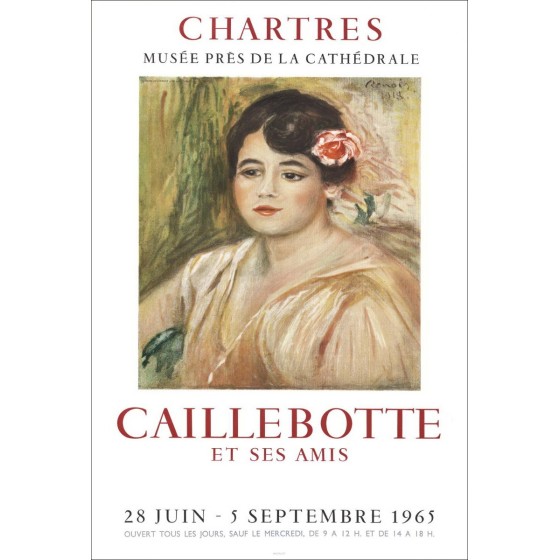
Vintage lithographed posters, published for exhibitions in the 1960s, are affordable collectors' pieces. Lithographs after his paintings allow you to live with his most famous images. Looking for a Renoir lithograph? Discover them above:
- Lithographs after his paintings: Jeunes filles au piano and Le Chapeau épinglé.
- Lithographed exhibition posters: Caillebotte et ses amis (1965), Galerie Knoedler in Paris (1966) and Musée Cantini in Marseille (1963).
Every work offered by the gallery is described in detail and sold with an invoice-certificate. It reaches you carefully protected, by tracked and insured shipping. Our art gallery near Metz, between Thionville, Nancy and Luxembourg, also welcomes you by appointment: discover the gallery. To continue the Impressionist journey, also discover Édouard Manet and Edgar Degas.
How much does a lithograph or poster after Renoir cost?
At the gallery, lithographed exhibition posters are offered at €85 and lithographs after his paintings at €195. Original prints by Renoir, for their part, trade from a few thousand euros.
Why is Renoir called the painter of happiness?
Renoir almost never painted sadness. Outdoor dances, lunches with friends, young women, children and bathers: his canvases celebrate the sweetness of life. He used to say that a painting should be a pleasant, joyful and pretty thing.
Where did Renoir spend his final years?
He lived in Cagnes-sur-Mer, at the Domaine des Collettes, among the olive trees. Despite the illness that deformed his hands, he continued to paint until the end. His house is today the Musée Renoir.
What is the connection between Renoir and cinema?
His son Jean Renoir became one of France's greatest film directors, author of La Grande Illusion and La Règle du jeu. He devoted a book of memoirs to his father, Renoir, mon père.
What is Auguste Renoir's auction record?
The small version of Bal du moulin de la Galette, painted in 1876, was sold for $78.1 million at Sotheby's in New York in May 1990, a record for the artist at that time. The large version is held in the Musée d'Orsay.
How can you tell a lithograph after Renoir from an original print?
A lithograph "after" reproduces an existing painting, such as Jeunes filles au piano. An original print, such as Le Chapeau épinglé published in Vollard's time, was conceived by the artist himself for the medium. The mention "after" in the gallery's title clearly indicates the nature of each work.
Do you own an oil on canvas, a watercolour or an original drawing by Auguste Renoir and wish to sell it? Discover how to proceed on our Sell a work page.