
SCHIELE Egon
Egon Schiele (1890-1918), Austrian painter and draftsman, a major figure of Expressionism, protégé of Klimt. Lithographs after his drawings.


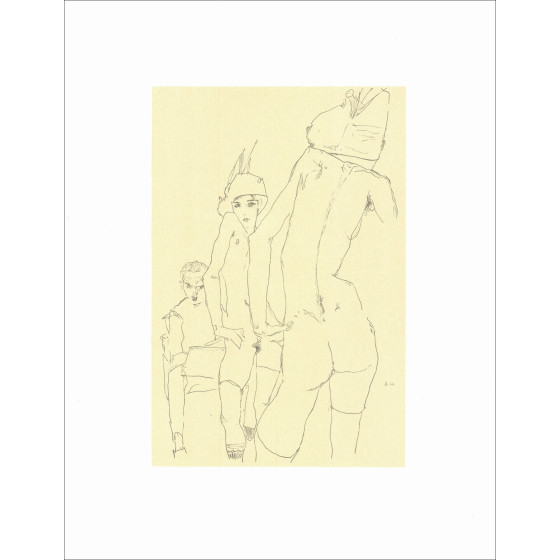


Egon Schiele, the Raw Line
Egon Schiele (1890-1918) is one of the greatest draftsmen of the 20th century and a major figure of Austrian Expressionism. A protégé of Gustav Klimt, he created in just ten years a body of work of unparalleled intensity: tormented self-portraits, angular nudes, and tense bodies, drawn with a nervous and uncompromising line.
Landmarks
- 1890: born in Tulln, Lower Austria, on June 12.
- 1906: enters the Academy of Fine Arts Vienna at sixteen.
- 1907: meets Gustav Klimt, who supports him.
- 1909: leaves the Academy and founds the Neukunstgruppe.
- 1911: meets Wally Neuzil, his model.
- 1915: marriage to Edith Harms, then mobilization.
- 1918: success at the 49th Vienna Secession exhibition.
- 1918: died in Vienna on October 31, taken by the Spanish flu, three days after his wife.
A drawing prodigy
Son of a stationmaster, Egon Schiele drew from childhood. Admitted very young to the Academy of Fine Arts in Vienna, he quickly felt constrained there. His encounter with Gustav Klimt was decisive: the master of the Secession encouraged him, introduced him to collectors, and presented him to his models. Schiele quickly emancipated himself from Klimt's ornamentation to invent an angular, broken, expressive line.
The Body, the Soul and the Scandal
Grimacing self-portraits, male and female nudes, entwined couples: Schiele explores the body with a candor that shocks Vienna of his time. His bold outlines, watercolor and gouache colors, and daring poses express anxiety, desire, and solitude. In 1912, some of his drawings were seized, and the artist spent several weeks in detention. He also painted landscapes and cities, notably Krumau, his mother's birthplace.
The Glory and the Brutal End
In 1918, the 49th exhibition of the Vienna Secession, for which he designed the poster, established Schiele as the leader of young Austrian painting after Klimt's death. A few months later, the Spanish flu claimed his life at twenty-eight, three days after his pregnant wife Edith. The Leopold Museum and the Albertina in Vienna now house his greatest masterpieces.
Choosing a Work by Egon Schiele
The lithographs based on his drawings capture the full nervousness of his line and the delicacy of his highlights. The large formats of 65 x 50 cm enhance his nudes and self-portraits, while the smaller formats allow for a composed ensemble. Each work offered by the gallery is described with precision and sold with an invoice-certificate.
Egon Schiele: prices and market value of artworks
Egon Schiele, who died at 28, left a rare and highly sought-after body of work, explaining the vast gap between reproductions and originals. The price depends on the nature of the work, the signature, the edition, the format, the subject, and the condition. As an indication, here are the generally observed ranges in the market, both in galleries and public sales:
- Lithographs and reproductions from his drawings: approximately €200 to €450.
- Original prints: extremely rare, he created only a handful.
- Drawings and watercolors: from several hundred thousand to several million euros.
- Paintings: from several million to several tens of millions.
The self-portraits, nudes with nervous lines, portraits of women, and urban landscapes of Krumau are the most sought-after subjects. For most collectors, lithographs after his drawings are the most accessible way to display Schiele at home.
What is Egon Schiele's auction record ?
Häuser mit bunter Wäsche (Vorstadt II), an urban landscape from 1914, was auctioned for over 24 million pounds, approximately 40 million dollars, at Sotheby's in London in June 2011, a record for the artist at that time.
Egon Schiele at Galerie 125
The gallery offers numerous lithographs after his drawings: "Femme nue couchée avec la jambe gauche levée" and "Deux femmes nues allongées" from 1914, "Homme nu accroupi (autoportrait) 2" and "Femme couchée" from 1918, "Couple allongé" and "Homme nu debout" from 1912, "La Fille debout sur ses genoux," "Fille nue avec les bras levés," "L'Hôte rouge," or "Fille rousse aux jambes écartées." Each artwork is carefully protected, tracked, and insured. Other great masters of drawing and expression to discover: Gustav Klimt, Paul Klee and Jules Pascin.
Do you own a work by Egon Schiele and wish to sell it? Learn how on our page Sell an artwork.