
CHAROY Bernard


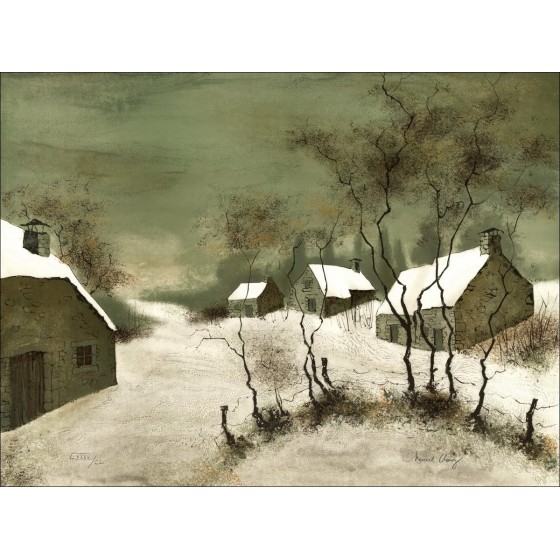
Bernard Charoy was born in 1931 into a family of Lorraine artisans. His creative and artistic heritage had a great influence on his work. Before entering school, he had already shown artistic talent. At the age of 11, he was creating drawings and illustrations that demonstrated great sensitivity and talent that went beyond mere technical mastery. As proof, a portrait he executed at 17 years old graced the cover of his book. Charoy settled on the Butte Montmartre in 1955 to learn and work at the Dejoie workshop. He began his apprenticeship with lithography and continued with the study of oil painting. He then embarked on a career as an illustrator in advertising agencies and newspapers. Charoy found the world of "advertising" too limiting. As he himself said: "I had much more freedom working with the press than in advertising." In 1961, his work as an illustrator was recognized by some of the most important publishing houses, from Edi-Monde to Opera Mundi. He visited his native region for a sort of pilgrimage that had a significant impact on his imagination and artistic maturity. In his landscapes, one can recognize an influence from Jacques Callot and Claude Gelée, known as "Le Lorrain". Artists from the School of Nancy such as E. Friant, Camille Martin, or Mucha made a strong impression on Bernard Charoy. They were the ones who created the sensual and organic forms of Art Nouveau. Their influence can later be seen in Charoy's celebration of feminine forms. It is important to note that the "fin de siècle" France found a very sophisticated and uncensored artistic expression, as evidenced by the cover of "Salambo" by G. Flaubert executed by Jean Prouvé and Camille Martin. Art Nouveau remained flourishing until the early 20th century. In the Paris of the Belle Epoque, beautiful, somewhat nude women advertised cigarettes and absinthe on the walls of cafes and cabarets. With the First World War, this spirit of optimism and joyful sensuality disappeared from the art of illustration. Only a few, like Bernard Charoy, renewed the imagination and the indolent reverie of this "joyful past."