
GROMAIRE Marcel
Marcel Gromaire (1892-1971), painter, printmaker and tapestry cartoonist, gave French modern art its massive figures, outlined in black, somewhere between Expressionism and tradition. Discover below his lithographs, including Portrait de femme, and his exhibition posters.

Marcel Gromaire
The monumentality of man and labour
Painter, printmaker and tapestry cartoonist, Marcel Gromaire (1892-1971) occupies a distinctive place in French modern art. His workers, peasants, nudes and landscapes of the North, built with rigour, form a serious yet warm body of work, somewhere between Expressionism and tradition.
From the North to Montparnasse: the career of Marcel Gromaire
Born in 1892 in Noyelles-sur-Sambre, in the Nord department, to a literature teacher father and a mother of Flemish origin, Gromaire began studying law in Paris. He abandoned it in 1910 for the free academies of Montparnasse, where he discovered Cézanne, the Fauves and the Cubists, while also studying the Flemish Primitives and Romanesque art in museums.
Seriously wounded in the Somme in 1916, he drew from the war his masterpiece, La Guerre, shown at the Salon des Indépendants in 1925 and now held by the Musée d'Art moderne de la Ville de Paris: five soldiers as massive as blocks of stone. The great collector Girardin supported him. In 1939, the State sent him to Aubusson with Jean Lurçat to revive tapestry. A professor at the École nationale supérieure des arts décoratifs, he received the Carnegie International Painting Prize from the Carnegie Institute in Pittsburgh in 1952. He died in Paris in 1971.
A monumental style: forms, colours and subjects
Gromaire painted man within his environment: workers, reapers, merchants, female nudes, landscapes of Flanders and views of Paris. His simplified, almost geometric forms, outlined in black, and his dense colours give each figure a sculptural presence. Independent, he refused to join any movement while engaging in dialogue with Expressionism and Cubism.
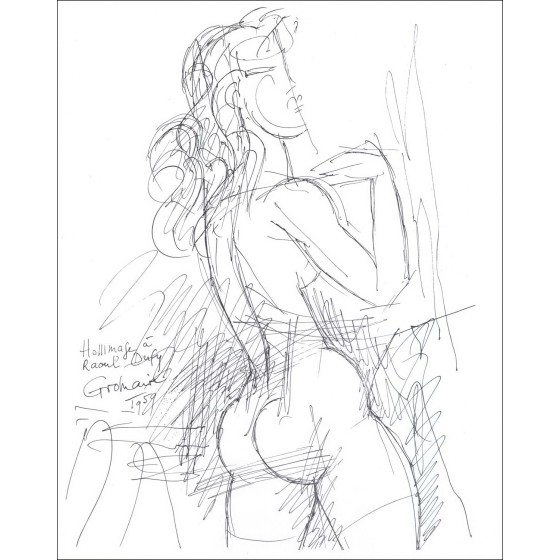
An important printmaker, he left numerous etchings and woodcuts, book illustrations, lithographs and ink drawings whose line reveals all his power. His exhibition posters extend that graphic strength.
Marcel Gromaire at Galerie 125
Discover above the lithograph Portrait de femme (1965) and several exhibition posters published in Paris and Saint-Denis:
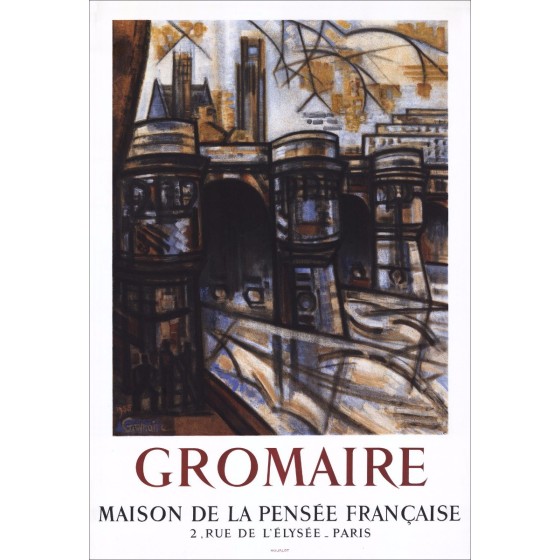
- Exposition Maison de la pensée française, Paris, 1956.
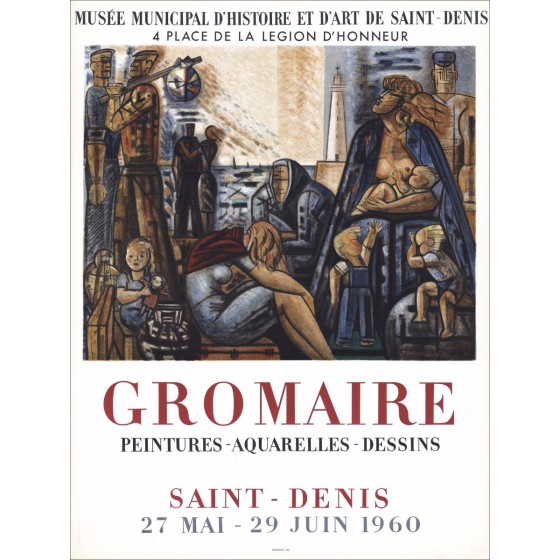
- Musée municipal d'histoire et d'art de Saint-Denis, 1960.
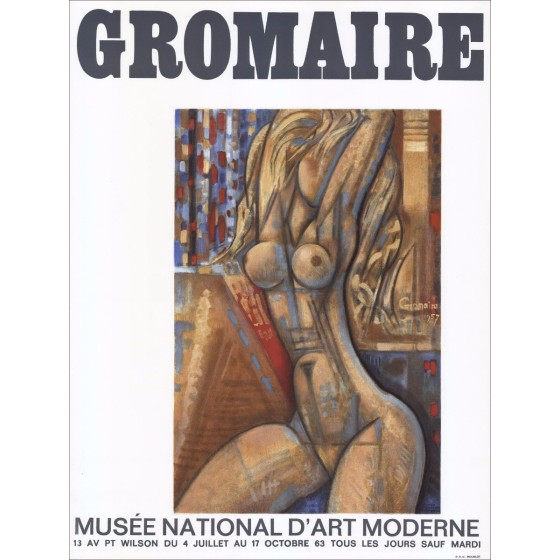
- Exposition au Musée national d'art moderne, 1963.
The ink drawing Barques sur l'Étang Forestier (1935) has found a buyer, and other works join the page as acquisitions are made. Each can be ordered online, with its certificate, and reaches you by careful, tracked and insured delivery. The gallery, in Argancy near Metz, also welcomes visitors by appointment. Also to discover: Édouard Goerg and Fernand Léger.
What is Marcel Gromaire's favourite subject?
Man at work: workers, peasants and reapers, along with nudes and landscapes of the North, treated as simple volumes.
Why did Gromaire work on tapestry?
In 1939 the State entrusted him with a mission to Aubusson, where he created large cartoons on the seasons and the work of the fields.
Did Marcel Gromaire belong to a movement?
No, he remained independent, while engaging in dialogue with Expressionism and Cubism.