
LABISSE Félix
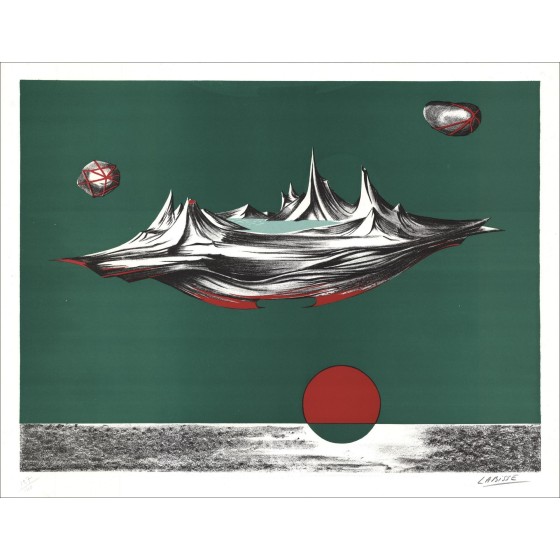
Félix Labisse (1905-1982), a painter of metamorphosis close to the Surrealist poets and a theatre designer, imagined a fantastical bestiary of unsettling precision. Discover below numerous original lithographs from his suite Histoire Naturelle (1974), signed and featuring his universe of creatures and muses with blue skin.


Félix Labisse
The Painter of Metamorphoses
Painter, illustrator and theatre designer, Félix Labisse (1905-1982) created one of the strangest and most poetic universes in twentieth-century French painting. Close to the Surrealists without ever joining the group, he painted women with blue or green skin, hybrid creatures and mysterious rituals, in a smooth and precise style that makes his dreams disturbingly real.
Biographical Landmarks
1905Born on 9 March in Marchiennes, in northern France
1923His family settles in Belgium, and he begins to paint
1920sEnsor in Ostend, the magazine "Tribord", first films
1927Divides his life between the Belgian coast and Paris, before settling there
1946Sets for Kafka's "The Trial" for Jean-Louis Barrault
1966Elected to the Académie des Beaux-Arts
1974Publishes the lithograph suite "Histoire Naturelle"
1982Dies in Neuilly-sur-Seine on 27 January
The Career of Félix Labisse
From Northern France to the Belgian Coast
Born in Marchiennes, in northern France, Félix Labisse followed his family to Belgium in 1923. In Ostend, he met the painter James Ensor, whose masks, skeletons and biting humour left a deep mark on him. He became involved with Belgian artistic circles, where the Surrealism of Magritte and Paul Delvaux was flourishing.
Paris, Poets and Theatre
Settled in Paris, he became friends with Robert Desnos, Paul Éluard, Jacques Prévert, Philippe Soupault and Jean-Louis Barrault, whose official designer he became. For more than thirty years, he designed sets and costumes for theatre, opera and ballet, notably for Kafka's "The Trial" and many productions by the Renaud-Barrault company. He exhibited in Paris, Brussels and New York, and his works entered numerous museum collections.
Recognition
Elected to the Académie des Beaux-Arts in 1966, Félix Labisse is recognised as one of the great figures of French fantastic painting, alongside Leonor Fini and Jean Carzou.
A Fantastic Universe, Between Dream and Strangeness
Labisse's painting explores the boundaries between the human, the animal and the vegetal. His women with blue, green or golden bodies, surrounded by monsters, birds and esoteric symbols, evoke forgotten myths. He blends eroticism, humour, magic and unease, with a technical virtuosity inherited from the Flemish masters. His titles, poetic and often enigmatic, extend this play with dreams.
Félix Labisse's Histoire Naturelle
In 1974, Labisse published a suite of lithographs entitled Histoire Naturelle, a genuine imaginary bestiary in which each plate presents a fantastical creature with an evocative name: Le Parsifal, L'Ophélie, Le Cyclope des Marais, La Tarentule des Lettres, Le Chérubin or L'Arthus des Sables. This suite sums up his whole art: the precision of his drawing, his humour and his taste for the marvellous. Brought together as a series, these plates form an ensemble of great decorative impact.
Félix Labisse Prices and Market Value: How Much Is a Work Worth?
The price depends on the technique, the signature, the numbering, the format, the subject and the condition. As a guide, here are the ranges generally observed on the market, both in galleries and at auctions:
- Lithographs: from €95 for standard plates, more for signed large-format proofs.
- Drawings and gouaches: from a few hundred to a few thousand euros.
- Paintings: several thousand euros, more for large compositions.
His female figures and his scenes of metamorphosis are the most sought-after subjects. An original lithograph, printed and pulled from a stone or plate drawn by the artist, is distinguished from a simple photomechanical reproduction by the fineness of its line and the depth of its flat areas of colour.
Buy a Work by Félix Labisse
Are you looking for a signed Labisse lithograph in the spirit of fantastic painting? The gallery brings together above a fine selection of lithographs from the 1974 Histoire Naturelle suite, in the 56x45 cm format. Among them, Le Parsifal, L'Ophélie, Le Chérubin or La Tarentule des Lettres. The plates can be collected one by one or as a set, to create a wall of fantastical creatures. Works are shipped promptly, carefully protected, with tracking and insurance. Each work offered by the gallery is described in detail and sold with an invoice-certificate. Enthusiasts of the fantastic will also appreciate Stanislao Lepri and Salvador Dalí.
How much does a lithograph or painting by Félix Labisse cost?
A lithograph from the Histoire Naturelle suite is available from €95, which makes it a very accessible entry point into his universe. Drawings, gouaches and especially paintings require a significantly larger budget.
Was Félix Labisse a Surrealist?
He was a friend of many Surrealist poets, including Desnos and Éluard, but he never officially joined the group. His painting, with its smooth and precise drawing, belongs rather to the fantastic and the marvellous.
What role did Félix Labisse play in the theatre?
As the appointed set designer of Jean-Louis Barrault, he designed sets and costumes for theatre, opera and ballet for more than thirty years, notably for Kafka's "Le Procès" in 1946.
What was Labisse's connection with James Ensor?
He met Ensor in Ostend in the 1920s. The masks, skeletons and grinding humour of the Belgian painter deeply marked his imagination.
Can the Histoire Naturelle plates be collected as a set?
Yes. Each plate presents a different creature, all in the same 56x45 cm format: they can be acquired one by one or a complete series built up gradually, with a strong decorative effect.
Why is Félix Labisse considered an academician of the fantastic?
Elected to the Académie des beaux-arts in 1966, he received official recognition for a body of work that was nonetheless dreamlike and unsettling, which makes him a major figure of French fantastic painting.
Do you own an oil on canvas, a gouache or an original drawing by Félix Labisse and wish to sell it? Find out how to proceed on our Sell a work page.