
DERAIN André
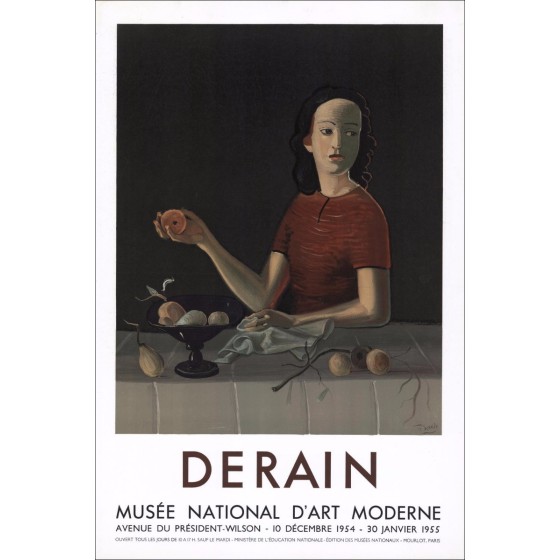

André DERAIN was born on June 10, 1880 in Chatou (Yvelines) and died on September 8, 1954 in Garches (Hauts-de-Seine). He was a French painter and one of the founders of Fauvism. He was also a painter of ballet and theater sets and costumes, as well as an engraver and illustrator.
Acknowledged as a pioneer of a new art movement, Fauvism, before the 1914 war, he shifted towards a realism with renewed classicism after 1918, reflecting his love for theater and literature, making him one of the major figures of the interwar period. Criticized at the Liberation for his collaboration, Derain was blamed and appeared after World War II as a survivor of an old world where "violence gave the illusion of strength."
André Derain was born in Chatou, into a wealthy family. His father, Louis-Charlemagne, was a dairy and ice cream seller at 87 rue Saint-Germain and a municipal councilor. His mother, Clémentine Angélique Baffé, had lost several young children, leaving only an older brother, René (1870-1890). André Derain was placed in a foster family in Orgeval. He began painting at around 15 years old while finishing his secondary studies at the Chaptal high school. At 18, he enrolled at the Camillo academy, led by Eugène Carrière, a friend of Pierre Puvis de Chavannes. In 1900, he met Maurice de Vlaminck on a suburban train. In 1901, he met Henri Matisse at the Louvre as they were both making copies.
As young struggling painters with Vlaminck, they shared a studio in Maison Levanneur in Chatou. Derain served in the military between 1901 and 1904. He began painting his first landscapes and illustrated Vlaminck's early novels, including "D'un lit dans l'autre." He also met the poet and critic Guillaume Apollinaire, who dedicated a poem to him in his collection "Alcools." Self-taught, he frequented museums regularly and enriched his aesthetic reflections with numerous readings (Zola, Nietzsche...). In addition to the decisive influence of Vincent van Gogh, whom he discovered in 1901, Derain was also influenced by the Neo-Impressionists and, above all, by the work of Paul Cézanne, whom he saw at the first Salon d'Automne in 1903.