

How to install and protect a work of art? :
Complete guide and professional advice
Welcoming a work of art at home is a strong gesture. Whether it's a painting, lithography, engraving or print, it's never a simple decorative object. It is a fragment of beauty, culture, emotion - and as such, it deserves special attention.
But how to install it well? Protect it? How high respect? Is it a window? Can we expose it to natural light? As many frequent questions, to which this guide intends to answer with clarity, method and common sense.
Through this text, we offer a panorama of good practices to adopt to integrate a work of art into your interior, whether old or contemporary, modest or valuable. You will discover that preserving a work, it is often dealing with simple gestures, common sense, and especially attention.
Why protect a work of art ?
Even in a clean, bright and temperate interior, a work of art is exposed to risks. These risks are sometimes imperceptible every day, but their effects are revealed over the years.
⚠️ The main threats:
- Light, in particular the UV, causes the progressive discoloration of pigments and inks, irreparably altering the work.
- Moisture promotes mold, gondolas or deformations, especially on paper or poorly stretched canvases.
- Temperature differences generate dilatations that weaken the supports and create cracks.
- Dust, When accumulating, can become abrasive, tarnish the colors or penetrate the fibers of the paper.
- Accidental shocks (Mal-fixed chart, unprotected displacement) cause sometimes irreparable damage.
Protecting a work does not mean overprotering or isolating it. It is a question of offering him a stable, moderate environment, and adapted to his nature.
Some works are well preserved with little precautions, others require more care. The secret lies in the understanding of their nature and in the attention we are wearing.
Under glass or not? It all depends on the type of work
Each artistic technique has its constraints, and there is no universal rule. The use of a window depends primarily on the support and sensitivity of the work to its environment.
Works on paper: lithographs, Engravings, drawings, watercolors ..
These works must imperatively be framed under glass. They are very sensitive to moisture and light, especially ultraviolets. Prolonged exposure without protection will eventually cause yellowing of paper, an alteration of inks, or even a weakening of the support.
The ideal is to use a uV glass, which effectively protects against harmful radiation, and a anti-reflection glass, which improves visual comfort by reducing parasitic gloss.
The frame must include a master key, or at least the enhancers, so that the paper is never in direct contact with the glass. This small space, often neglected, prevents the work sticking to the glass, especially in case of condensation or punctual humidity.
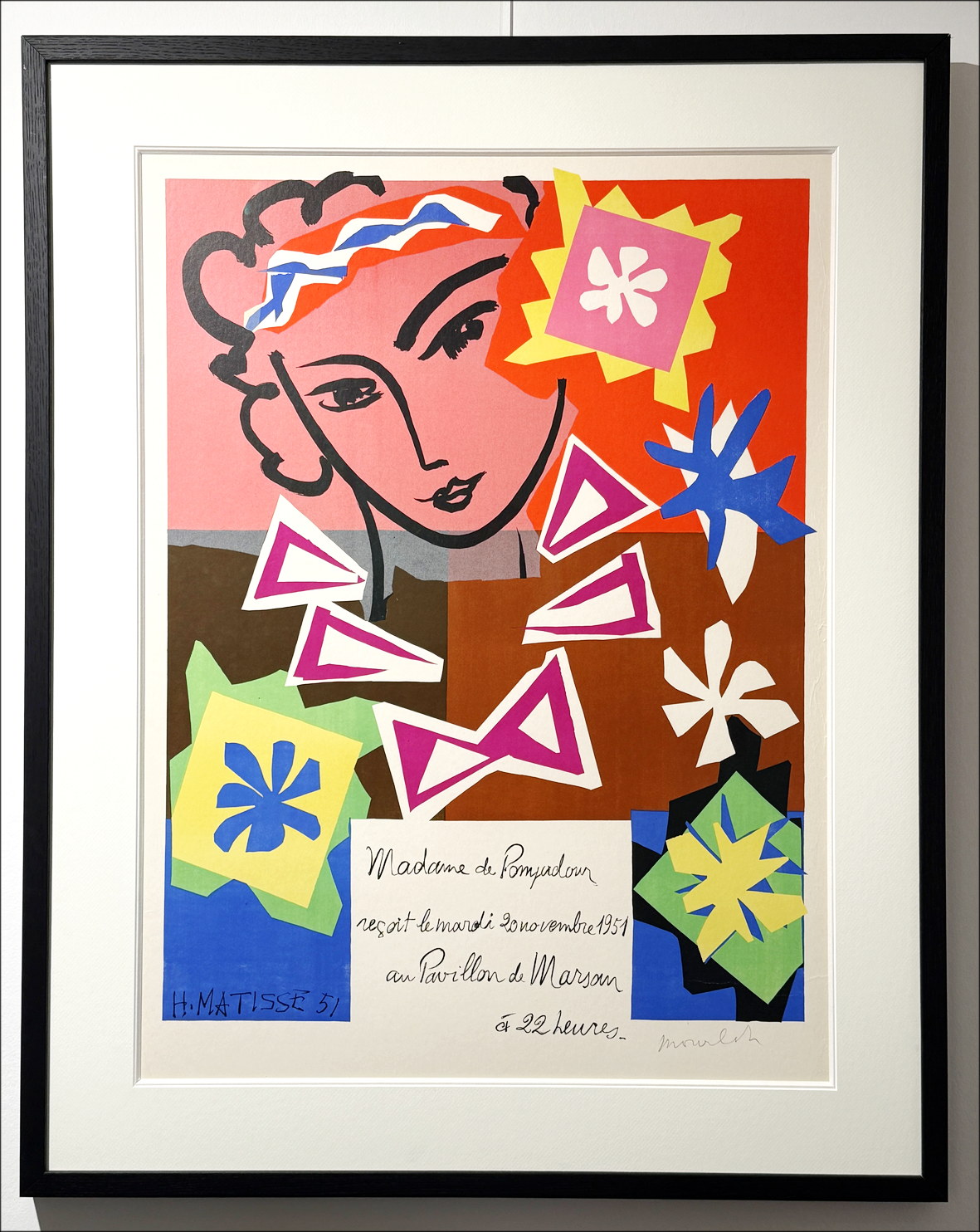 Example of custom frame for this original lithograph of Henri Matisse
with Passe-everywhere Bevel and anti-reflective glass, anti UV
Oil paintings or acrylic on canvas
Unlike works on paper paintings on canvas should not be made under glass. These techniques are more durable and designed to live in the open air, provided the canvas is tense and the pictorial layer is protected by a suitable varnish.
A framed paint under glass may be locked in a microclimate. This containment may result in condensation, stagnation of moisture, or even softening of varnishes or paints in some cases. In short, it does more harm than good.
Some museum institutions use specific glazings for some very fragile works, but under strictly controlled conditions, with precise regulation of moisture and temperature. It is not transposable to a domestic framework.
To showcase a painting on canvas, several types of framing are possible:
- the US fund, widely used for contemporary canvases, gives a floating impression of work. It surrounds the work without hiding the edges and strengthens the elegance of the presentation.
- The classic wand, more discreet, suitable for works whose edges are not painted or that require sober and efficient framework.
- The inverted box, deeper, gives a sculptural effect to work and is particularly suitable for generous formats or relief works.
- the ornamental framework, often golden or carved, emphasizes the classic or noble aspect of an old painting, but can also create a bold contrast with a modern work.
Each type of coaching participates in the staging of the work, but also to its mechanical protection.
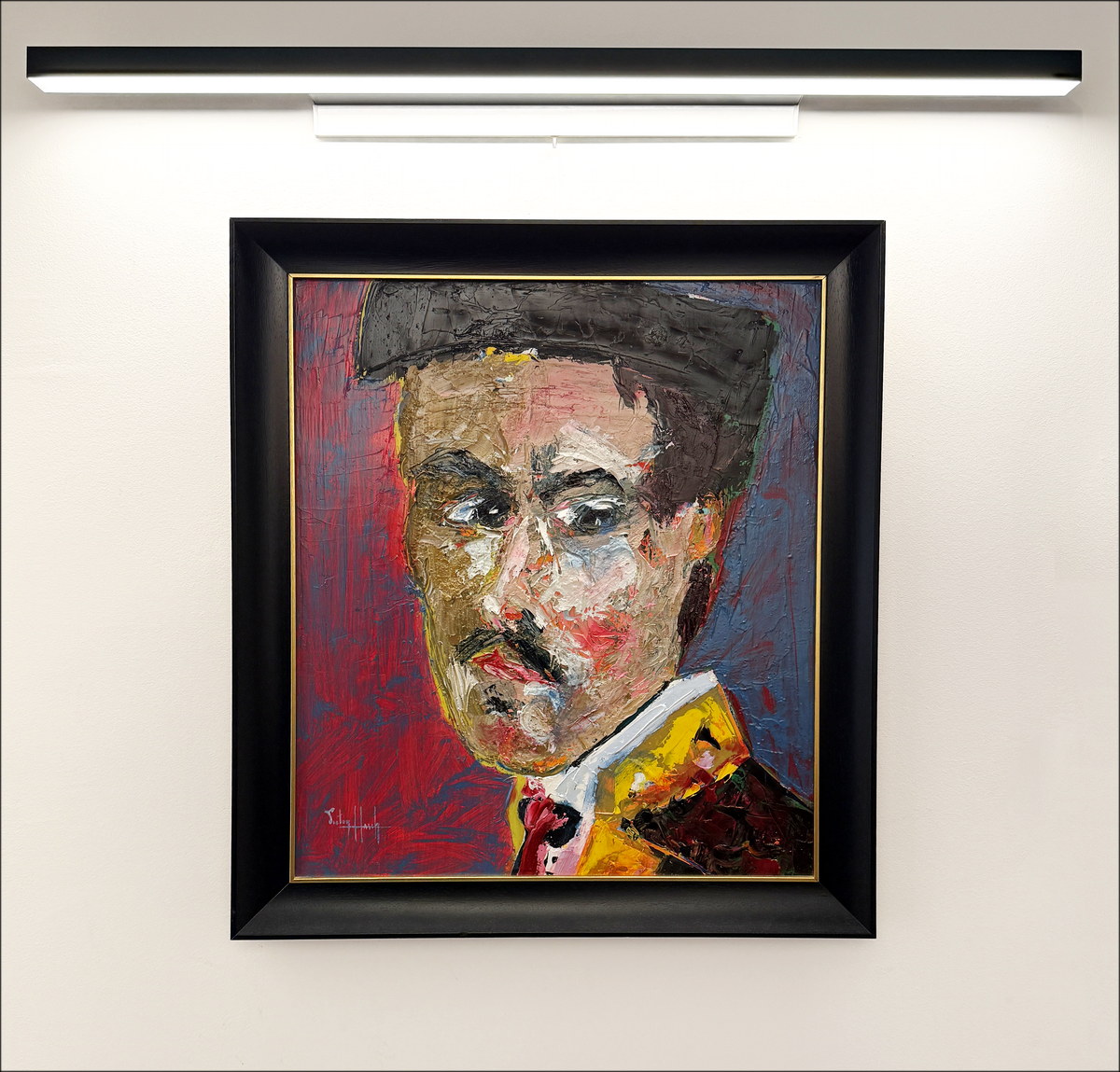 Example of custom frame for original painting with acrylic on canvas Victor hasch
Wall lamp and cimaise.
Watercolors
The watercolors are among the most sensitive works in light. Made from pigments diluted in the water, often on a light paper, they must absolutely be framed under glass with a passworm. Prolonged exposure to light, even indirect, can make them disappear almost entirely.
Photographs
The photographic prints, whether they are argentic or digital, must be protected under glass or plexiglass. Modern photo papers are often more resistant than the ancients, but they remain sensitive to moisture and scratch. The museum, Although more expensive, offers excellent protection without visual deformation.
Mixed or relief works
Some works combine painting, collage, various materials. They require an assessment on a case-by-case basis. If the work is flat, it can be framed with a breathing space. If it is in relief, consider a box or a plexiglass bell to avoid any contact.
Where and how to hang a work of art ?
Hang a Artwork, It is to offer him a coherent, valuing and safe living environment. It begins with the choice of the wall, but also by a reflection on height, light, surrounding volumes and fixation itself.
How high suspend a work ?
In gallery or museum, a simple rule is generally applied: the center of the work must be about 1.50 m from the ground. This corresponds to the average height of an adult standing. This rule, although empiric, is very effective because it guarantees immediate reading comfort.
However, this height can be modulated according to the constraints of the room: furniture, chimney, sofa or space under slope. Everything is to keep a visual harmony throughout the room. Do not hesitate to take a step back, test different heights with a cardboard of the same format or even to make a light marking on the pencil wall.
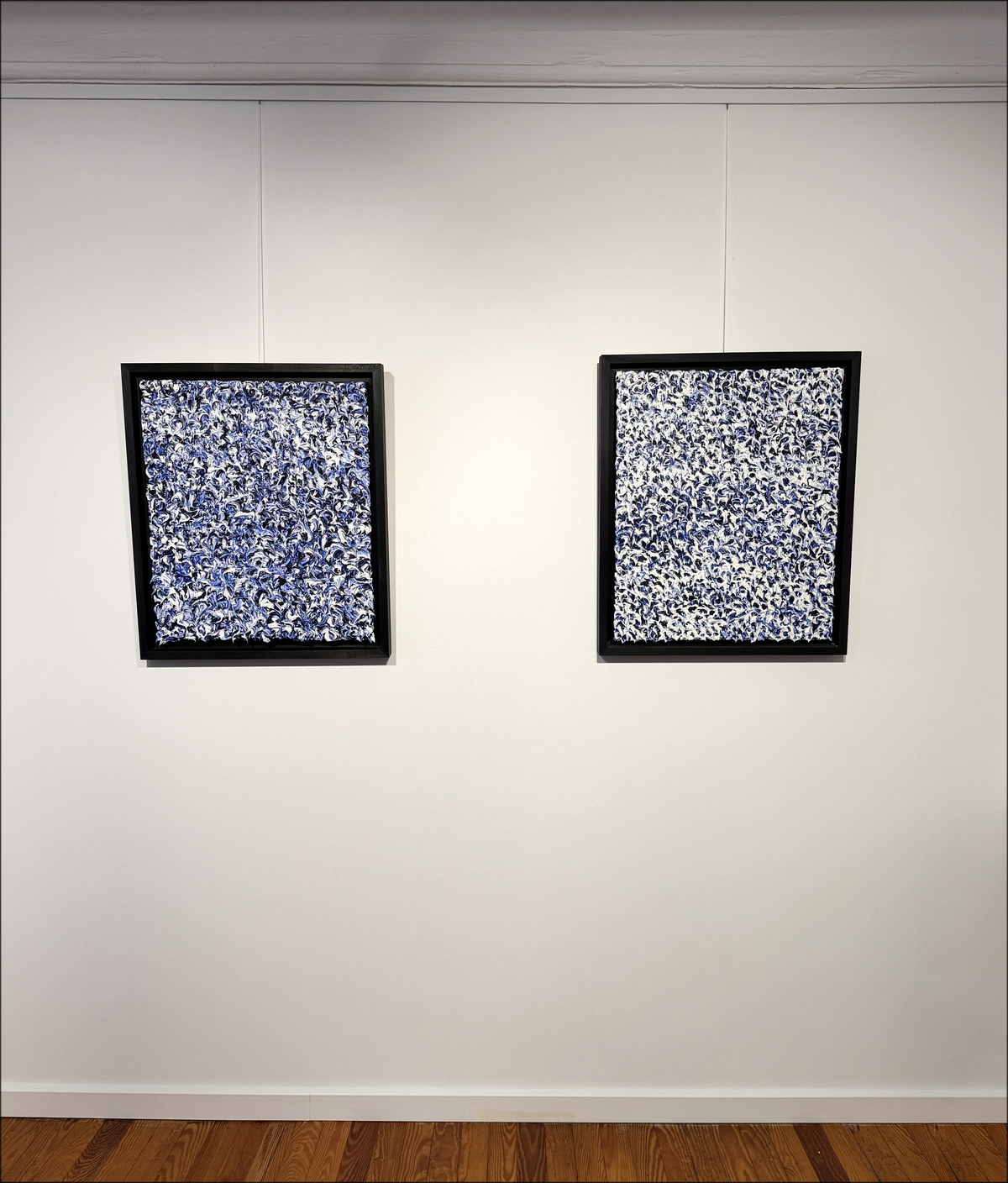 Acrylics on canvas TANC "Ultramarine" supervision in American box, hanging by transparent son on culpse
Height of 1.50 cm between the floor and the center of the painting for a perfect visibility of the works.
Fixing and safety
The fixation deserves special attention, often underestimated. An ill-hung work can get off, lean, or even fall - with dramatic consequences for the work as for people.
Two main methods coexist:
- The central wire, attached to the back of the work and suspended on a single hook, is widely used for small and medium formats. It allows quick installation, makes adjustments easier and reduces the number of holes in the wall. However, it tends to slightly tip the work forward, which can be embarrassing on framed pieces with glass.
- Double fixation, with two square brackets on the wall, is more stable. It is particularly recommended for heavy works, large formats or framing under glass. It ensures a better weight distribution, reduces the tensions on the frame and guarantees a perfectly straight presentation.
Adapt the mounting to the wall
All walls are not worth. It is essential to use a system adapted to the nature of the support:
- Full wall (concrete, stone, brick) → Anchors + solid screws
- Creuse partition (Plapo, insulation dubbing) → Toggle hooks or specific dowels
- wall cimaises or ceiling → Ideal to change the hanging regularly without drilling the wall
We regularly use the products of Shop to suspend works in our gallery: reliable, aesthetic and easy to install.
One last tip ?
Always take the time to test the strength of your fasteners. A suspended work must not tang or crack when handled slightly. Also remember to control your clashes after a move, work or change of ambient humidity.
A good fixation is also a peace of mind every day.
☀️ Exposure to light: friend or enemy ?
The light is essential to reveal a work of art, but it can also become its worst enemy if it is poorly managed. Too strong, poorly oriented or miscarriage, it can damage the colors, paper or varnishes irreparably.
Natural light: to handle carefully
The sun's rays, rich in ultraviolet, are extremely aggressive for works of art. Prolonged exposure, even indirect, may result in:
- Discoloration of pigments
- a yellowing of paper
- Fragilization of glues or varnishes
- deformation of the support.
Even behind a glass, solar radiation remains active. Hence the importance of never place a work in front of a sunny window or on a southern unprotected wall.
Tip : Use light ships, curtains or anti-UV movies on glazing. There are also special glazings integrating UV filters, very useful for highly exposed parts.
And the light of the moon ?
It is imagined harmless, because soft and poetic. Yet the light of the moon is a partial reflection of that of the sun, and therefore transports a very small amount of ultraviolet rays.
It's not a source of immediate danger, but on the very long term, and if the work is exposed each night to a large unprotected glass bay, this can contribute to a light yellowing of paper, in particular if it is old or acid.
In doubt, it is better to protect sensitive works, even at night, or consider a light curtain or reorientation of the attachment.
Artificial light: Which source choose ?
A bad artificial light can also be problematic. Halows, for example, emit heat and sometimes UV. The neon, meanwhile, have a discontinuous light spectrum that can alter some works.
✔️ prefer lED spots, low consumption, without heat emission, adjustable intensity and if possible with a IRC (color rendering index) high to faithfully restore the shades.
✔️ always orient the light so indirect, or with a diffuser. Zenithal or shaving lighting creates reflections and can dazzle. A soft and well distributed light will put more work in value, while respecting it.
How to maintain and clean a work of art ?
Possessing a work of art, it's also taking care of it every day. But beware: well maintain does not mean intervene at all costs. In many cases, it's mostly not not make mistake, more than wanting too much to do it. Here are some simple tips to preserve your works without damaging them.
Paintings on canvas: discretion and delicacy
Oil or acrylic paints, once dry and varnished, are generally stable. That said, they remain sensitive to dust and the environment. For lightweight maintenance, it is enough:
- a soft brush (Badger type or makeup brush),
- or a antistatic feather, passed without supporting, on a regular basis.
⛔ Never use water, damp cloth or clean cleaning product.
In case of stain, deposit or doubt, better to abstain and use a professional restaurateur. Inappropriate intervention can result in irreversible damage.
Works under Glass: Attention to reflections, not inside
When the work is protected by a window, cleaning is only the outside of the glass.
✔️ Use a dry microfiber cloth or slightly humidified
✔️ Spray the products (window cleaner type) cloth, never directly on the glass
✔️ Be attentive to ancient or gold frames : Avoid any liquid or abrasive, and just do a dry cloth
Never attempt to open the frame if you do not know how it was mounted. Some systems are complex, and a false movement can dislodge or damage the work.
Works in reserve: how to store them ?
All works are not intended to be permanently attached. For works preserved flat (lithographs, drawings ...), here are some rules to follow:
✔️ Store in a room dry, temperate, without direct light
✔️Between two sheets of crystal paper or neutral paper
✔️ inside a drawing card or drawer, ideally horizontally.
Remember to wear cotton gloves when handling, especially for unfattered works. The simple contact of the skin can leave traces of moisture or acidity.
Tips for keeping your works in the long term
Take care of your works does not stop at their snap or a good supervision. It's in the regularity of small gestures, in the discreet vigilance of everyday life, which resides their true conservation. Here are some helpful and often neglected tips:
Turn your works
Even the best protections can not completely counter the effects of light or micro-temperature. Alternate the exhibition of your works, especially those on paper, allows to limit their visual fatigue. It is also an opportunity to rediscover pieces that you may have forgotten.
Avoid risk locations
Some areas of the house are to be avoided, as much as possible:
⛔Above a radiator : Too much dry and ascending heat
⛔Near a glazed bay or a skylight : excess UV radiation
⛔In the kitchen : Steam, grease and smell
⛔In the bathroom : fluctuating moisture, risk of mold.
Focus on stable walls, without air current, with a regular ambient temperature.
Watch for hygrometry
The relative humidity of the air is a crucial factor. Too low, it dries the canvases and weaken glues; Too high, it favors mold and gondolages. The ideal is around 50% relative humidity. A hygrometer may be enough to keep an eye on this variable.
Regularly inspect your works
A small visual control from time to time does not cost anything and helps quickly detect:
- A frame that is loosening
- A tie that tires
- Discreet discolouration
- a trace of moisture on the bottom of the frame.
These warning signs allow to act in time, without waiting for a problem settles.
Store the documents related to your works
Certificates of authenticity, invoices, records, letters of origin ... All these elements are valuable, not only to guarantee the origin of the work, but also for your insurance or in case of resale.
➡️ Keep them apart, in a secure, dry place, and easily accessible. A work without documentation loses its readability and, sometimes, of its value.
✅ In summary
Install and preserve a work of art at home does not require museum expertise. It is most often enough to good sense, observation and a few simple precautions.
By retaining these essential points, you put all the chances on your side to:
- Fully enjoy your works,
- preserve them in the long run,
- Transmit one day a heritage in good condition.
And if any doubt persists, do never hesitate to seek advice to a professional, whether it's a supervisor, a restorator or a gallery.