

Matisse Exhibition 1941-1954 at the Grand Palais, the final revolution of an absolute master
In Paris, some exhibitions mark a season. Others mark an era.
With Matisse, 1941-1954, Presented from March 24th to July 26th, 2026, the Grand Palais offers much more than a retrospective: a dive into the latest transformation of an artist who, on the threshold of the end, redefined the very foundations of creation.
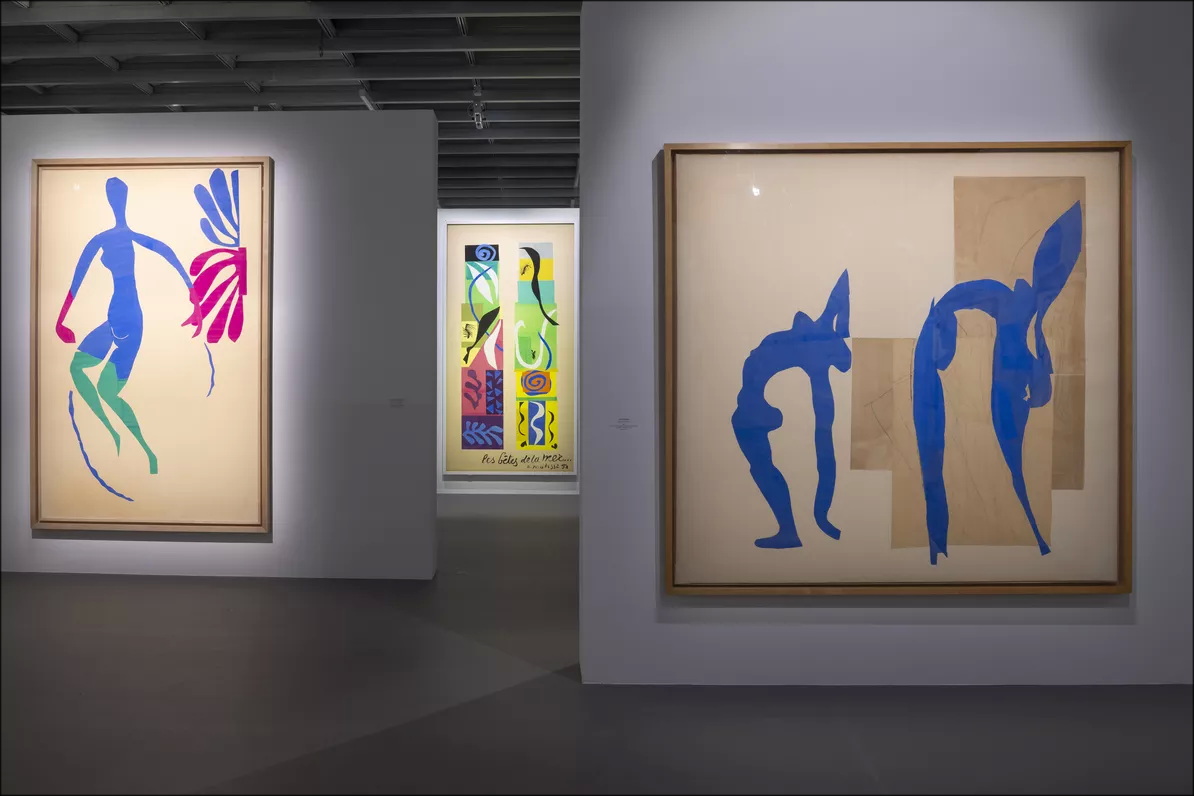
More than 300 works, from the Centre Pompidou and major international collections, trace this decisive period. Paintings, drawings, cut-outs, illustrated books, stained glass, textiles, and monumental projects engage in a dense, immersive journey designed as a living space. Here, Matisse does not tell his story. He reinvents himself !
 © photo Luc Castel, courtesy Centre Pompidou and Grand Palais
A Matisse exhibition focused on the essentials: the years 1941-1954.
The choice to focus on the years 1941 to 1954 is not insignificant.
It is a short period, but of rare intensity, where everything accelerates.
In 1941, Henri Matisse underwent major surgery. He thought he was living his last months. This pivotal moment acted as a trigger. The artist entered what he himself described as a "second life".
This shift is at the heart of the exhibition.
Deprived of some of his physical abilities, often bedridden, Matisse does not slow down. He transforms his practice. He simplifies, radicalizes, experiments. He abandons certain constraints to invent others, more free. What the exhibition Matisse 1941-1954 shows is precisely this tension between physical fragility and creative power.
An emergency to create that redefines the work
At Matisse's, the end is not a slowing down. It's an acceleration.
The testimonies from that time, such as those of Commissioner Claudine Grammont, emphasize this sense of urgency that imposes itself on him. Time is no longer an abstraction. It becomes a driving force.
During this thirteen-year period, Matisse produced an impressive quantity of works, while simultaneously exploring several directions:
➤ back to drawing with a brush
➤ series development
➤ monumental projects
➤ work on the illustrated book
➤ invention of cut-outs gouaches
The exhibition captures this simultaneity. It shows an artist in constant motion, moving from one medium to another without hierarchy.
 © photo Luc Castel, courtesy Centre Pompidou and Grand Palais
The cut-out gouaches, a language invented towards the end of life
This is undoubtedly one of the most anticipated points of the Matisse exhibition at the Grand Palais.
Starting in the 1940s, Matisse developed a technique that would become iconic: cut-out gouache.
The principle is simple in appearance. He paints leaves, cuts them out, and then assembles them.
But the scope is immense.
With this technique, Matisse no longer draws before painting. He draws directly in color. The gesture is immediate, almost instinctive. The form emerges from the movement.
This shift profoundly changes his relationship to space.
The compositions become more open, more direct, sometimes monumental. The drawing disappears in favor of a pure articulation between form and color.
In the exhibition, these works hold a central place. And for good reason: they embody the culmination of a research that began much earlier.
Major works brought together, a rare event.
One of the strengths of this Matisse 2026 exhibition lies in bringing together collections that are usually scattered.
Some works from the largest international institutions - MoMA, Metropolitan Museum, National Gallery of Art - are exceptionally presented together.
The journey allows you to discover, in a continuity rarely possible:
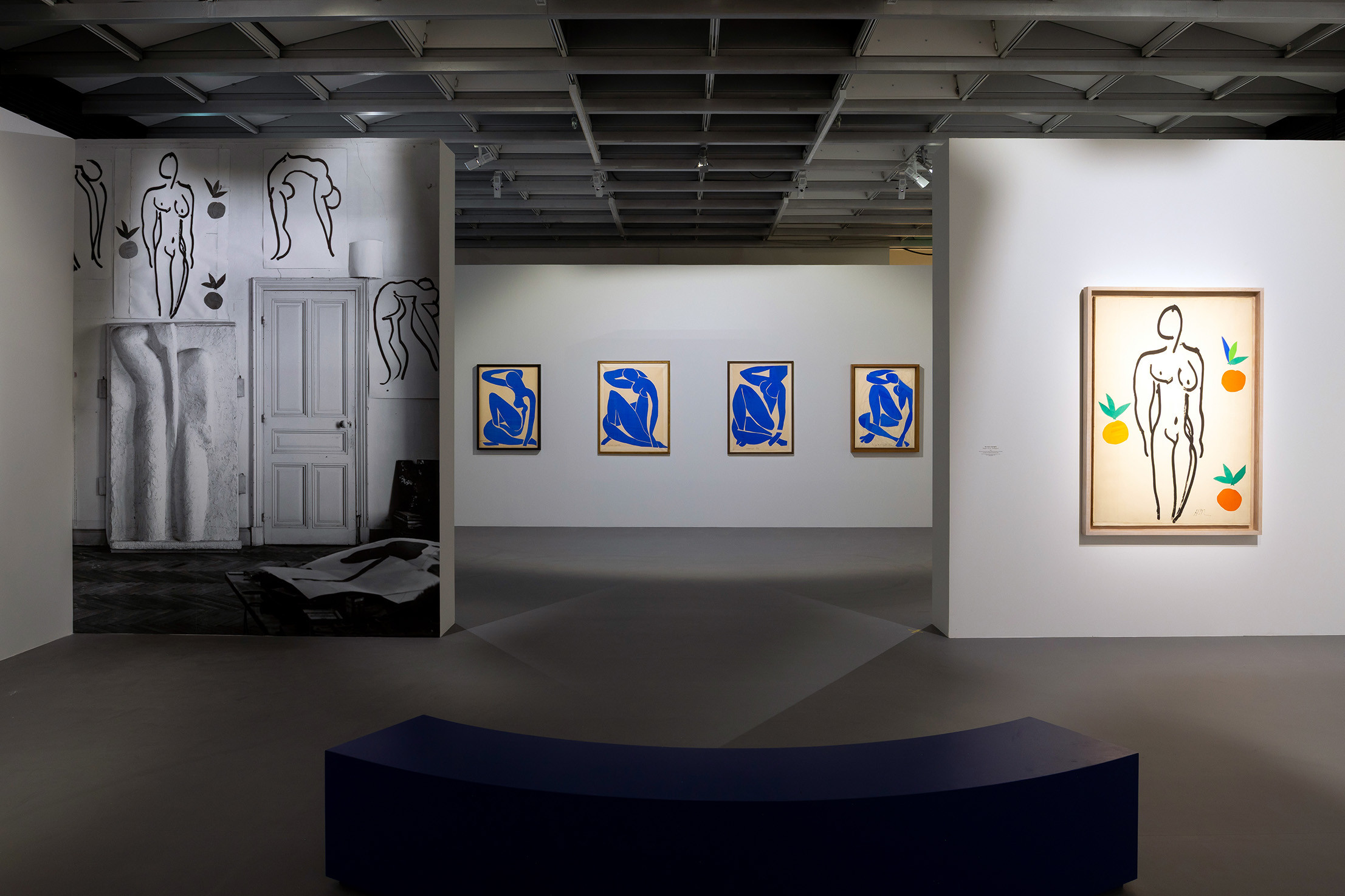
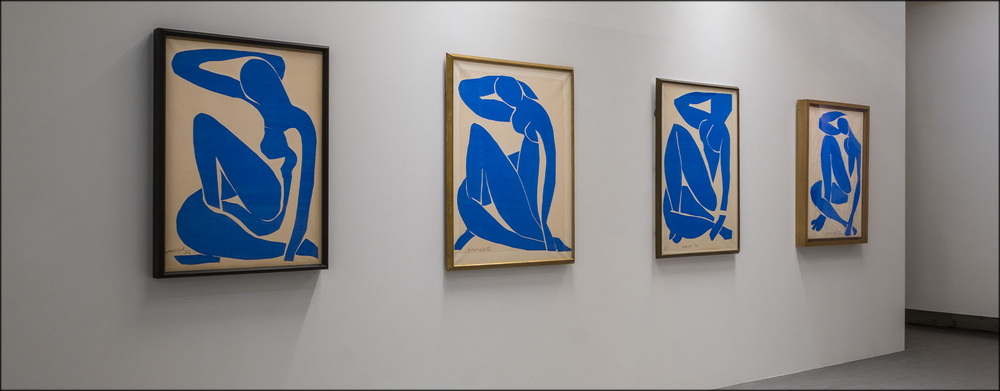
➤ the series of "Nus bleus" translates to "blue nudes" in English., gathered in its entirety
I'm sorry, but it seems like you haven't provided any text for me to translate. Please provide the text you would like me to translate from French to English.The Sadness of the King, ultimate and monumental work
I'm sorry, but it seems like you haven't provided any text for me to translate. Please provide the text you would like me to translate from French to English.The Sheaf This text is not complete. Can you please provide more context or the full text so I can accurately translate it for you? Acanthes
It seems like you haven't provided any text to be translated from French to English. Please provide the text you would like me to translate. The Snail
It seems like you haven't provided any text to be translated from French to English. Please provide the text you would like me to translate. Memory of Oceania
This concentration of works transforms the visit. It allows one to understand not only each piece, but also the relationships they have with each other.
Henri Matisse: His work, his museum, .. | France3 report
Painting and cutting, an essential cohabitation
Contrary to popular belief, cut-out gouache does not replace painting in Matisse's work.
The exhibition emphasizes this essential point: the two practices coexist.
The Vence Interiors, carried out between 1946 and 1948, are a striking proof of this.
In these paintings, the color spreads, the space expands, and the composition sometimes seems to overflow from the frame.
Matisse pushes the principles of Fauvism to the extreme. But at the same time, on the walls of his studio, cut-out shapes multiply.
The artist works on several pieces at once. They move, adjust, and recombine. Their studio becomes a space in constant transformation.
This is the dynamic that the exhibition captures.
Jazz, or the art of printed image
Among the highlights of the journey, the album Jazz occupies a special place.
Published in 1947, this work marks a decisive step in Matisse's career.
The boards, derived from the cut gouaches, are reproduced there using the stencil technique.
But beyond the editorial object, Jazz reveals a new relationship between art and reproduction. Matisse explores various themes - circus, mythology, war - with total formal freedom. Images like Icarus are now among the most emblematic of his work.
The exhibition presents both the panels and their creation process, allowing to grasp the complexity of this approach.
The Chapel of Vence, the total work
It is impossible to mention the end of Matisse's career without referring to the Chapelle du Rosaire in Vence.
Between 1948 and 1951, the artist conceived the entire project: interior architecture, stained glass windows, ceramics, and liturgical furniture. It is a complete work, where all dimensions of his practice come together.
In the exhibition Matisse 1941-1954, several elements of this program are presented, including studies and stained glass windows. There is an extreme simplification of the plastic language. The forms become signs. The colors, reduced to a few tones, structure the space.
A scenography conceived as a living workshop
One of the most successful aspects of this exhibition lies in its scenography.
The journey does not follow a simple chronology. It is designed as a traversal of Matisse's studio. The artworks engage in dialogue with each other. The formats vary. Spaces open up and close in on themselves. The visitor is not faced with an accumulation, but rather at the heart of a process.
This immersive approach allows for a better understanding of how Matisse truly worked: in an environment that was constantly evolving, where each work influenced the others.
Color as an experience
Seeing the Matisse exhibition at the Grand Palais is also experiencing an intense visual experience.
At Matisse's, color is never decorative. It is structure, rhythm, emotion. The saturated reds of the interiors respond to the deep blues of the Nudes. The cut-out forms vibrate in space. The contrasts are bold and deliberate. This chromatic power largely explains Matisse's lasting influence.
 © photo Luc Castel, courtesy Centre Pompidou and Grand Palais
Matisse and women, a constant presence
Another common thread in the exhibition is the emphasis placed on female figures.
Models, assistants, muses, they are omnipresent in theMatisse's work.
From Lydia Delectorskaya to the stylized figures of the Blue Nudes, the female body becomes a central motif, explored in all its forms.
Far from being just a subject, it contributes to the construction of the artist's visual language.
A major exhibition in Paris in 2026
In the Parisian cultural landscape, the Matisse 2026 exhibition stands out as a central event. Due to its scale, the quality of the works presented, and the relevance of its approach, it goes beyond a simple retrospective. It offers a fresh interpretation of Matisse, focusing on a period that has long been considered secondary but emerges as fundamental here.
Practical information, Matisse exhibition at the Grand Palais
Grand Palais, Galleries 3 and 4
17 Avenue du Général Eisenhower 17 General Eisenhower Avenue
75008 Paris
From March 24th to July 26th, 2026
From Tuesday to Sunday, 10am to 7:30pm - Open late on Fridays until 10pm.
Full price: 19 €
Reduced rate: 16 €
Free under conditions
Reservation: https://www.grandpalais.fr/fr/billetterie/offres/p83
Audio guide available
An edition of the Blue Nude II offered at Gallery 125
On the occasion of the exhibition Matisse, 1941-1954, we present a prestigious edition inspired by the "Nus bleus" translates to "blue nudes" in English., major figures of the artist's last period.
Created using three-color silkscreen printing on fringed-edge Arches vellum paper, measuring 65 x 50 cm, this edition bears a graphite signature. It accurately captures the balance of forms and intensity of color blocks characteristic of Matisse's work, while respecting his artistic language. Designed to harmoniously fit into an interior, it extends the spirit of this essential period without diminishing its strength or readability.
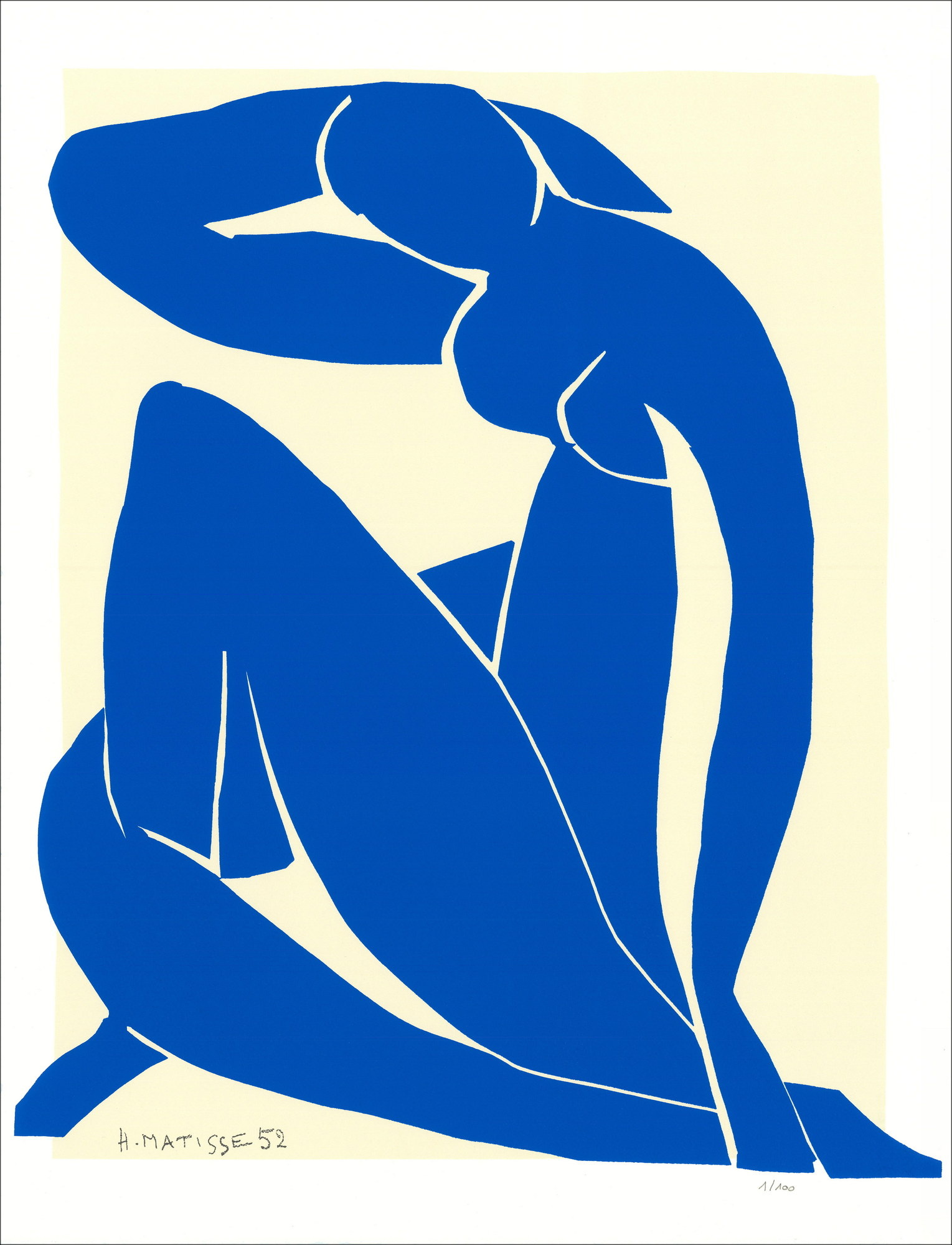 Henri Matisse "Blue Nude II" Serigraphy on Arches paper 65x50cm
Deluxe edition, with graphite signature.
Blue Nude II (1952), an emblematic work by Henri Matisse, is part of the famous series of Blue Nudes created with cut-out gouache paper, a major technique from the end of his career, often executed with a direct and spontaneous gesture.
Created in Nice in the workshop of the Regina hotel, this iconic composition, now preserved at the Centre Pompidou, testifies to the culmination of his research on the representation of the body and space.
Taking up a motif of a seated nude that he had already explored in his previous paintings and sculptures, Matisse simplifies the form here to its essence, fragmenting the body into blue flat areas while maintaining a strong visual coherence. The originality of this series lies in the use of the spaces between the forms, which become structuring elements, suggesting volumes, articulations, and movement, and allowing the figure to interact with the surrounding space.
Far from a simple deconstruction, these cuts reflect a deeply mastered vision where light flows freely, giving the body an almost living and breathing dimension.
Presented notably at the exhibition "Matisse, 1941-1954" at the Grand Palais, Nu bleu II appears as a key work of themodern art, illustrating Matisse's ability to renew the codes of the figure and push the boundaries between painting, sculpture, and space, in a highly modern artistic research with remarkable expressive power.
What the Matisse 1941-1954 exhibition really reveals
Beyond the exceptional gathering of works, the exhibition highlights a deeper transformation that goes beyond mere stylistic evolution.
Faced with illness and a keen awareness of time, Matisse embarked on a process of radical simplification. He no longer sought to enrich his language, but to tighten it. Forms were reduced to the essential, color emerged as structure, and the gesture gained immediacy.
This shift marks a fundamental change: it is no longer about representing, but about condensing. It is about extracting from reality a sensation, a presence, a true form.
In this economy of means, Matisse achieves a rare form of clarity. What may seem like simplification actually becomes an intensification.
This final period, long perceived as late, emerges here as one of the most defining of his work. It sheds light on his entire career and extends its significance far beyond painting.