
MATISSE Henri
Henri Matisse (1869-1954), French painter, draughtsman, printmaker and sculptor, is the leader of Fauvism and the inventor of the cut-out gouache papers. Below you will find his colour lithographs, the plates of Jazz, the screenprint Nu bleu II, his compositions for Verve and his exhibition posters.




- Out of stock


Henri Matisse
Colour as Joy
Henri Matisse (1869-1954) is, alongside Pablo Picasso, the artist who most profoundly transformed twentieth-century painting. A leader of the Fauvist movement, a master of pure colour and later the inventor of the celebrated cut-out gouache papers, he left a luminous body of work whose lithographs, posters and editions of the magazine Verve remain highly sought after by collectors.
Biographical Milestones
1869Born in Le Cateau-Cambrésis, in northern France
1890Discovers painting during a period of convalescence
1892–1898Studio of Gustave Moreau, meets Marquet
1905Collioure with Derain, the "cage of wild beasts"
1917First stays in Nice, where he settles permanently
1941Surgery leads him to invent the cut-out gouache papers
1947Publication of Jazz with Tériade
1948–1951Rosary Chapel in Vence
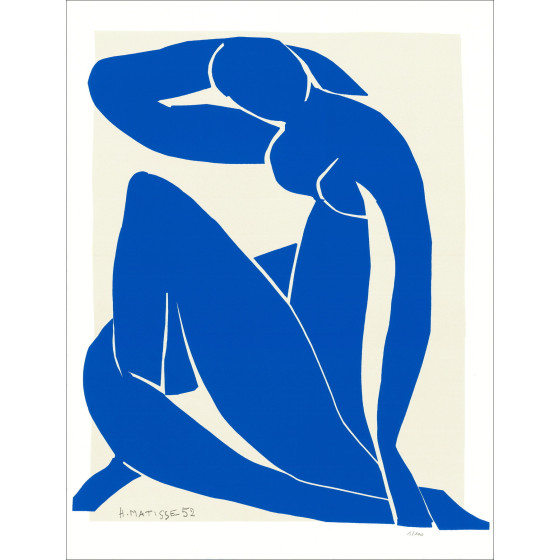
1952The Blue Nudes series in cut-out paper
1954Dies in Nice, on 3 November
The Career of Henri Matisse
From Law Studies to Gustave Moreau's Studio
Nothing predestined Henri Matisse for painting. After studying law, he worked as a legal clerk in Saint-Quentin when a long convalescence in 1890 led him to discover the paints his mother gave him to keep him occupied. The revelation was immediate. He moved to Paris, attended the Académie Julian and then the studio of Gustave Moreau at the École des Beaux-Arts. He copied the old masters at the Louvre, discovered Cézanne and the Neo-Impressionists, and gradually found his own path.
Fauvism, a Revolution of Colour
In the summer of 1905, at Collioure, Matisse and Derain freed colour from any descriptive obligation. Exhibited at the Salon d'Automne that same year, their canvases in pure tones earned the group the nickname "Fauves" (wild beasts), coined by the critic Louis Vauxcelles. Around them gravitated Marquet, Maurice de Vlaminck and Raoul Dufy. Then came the large decorative compositions, such as The Dance and Music, commissioned by the Russian collector Sergei Shchukin, in which Matisse reduced form to its essentials.
Nice, Light and Odalisques
From 1917 onwards, Matisse settled in Nice. The light of the Mediterranean inspired interiors opening onto the sea, odalisques and still lifes with decorative motifs that brought him international renown. He also travelled, to Tahiti in 1930, and then produced for Dr. Barnes, in the United States, an immense mural Dance.
Cut-Out Papers, Jazz and the Vence Chapel
Weakened by an operation in 1941, Matisse invented a new technique: "drawing in colour" with scissors, cutting into sheets painted in gouache. The book Jazz, published by Tériade in 1947, is its manifesto, with its clowns, cowboys, knife-thrower and sword-swallower. There followed the Rosary Chapel in Vence, which he designed entirely, from the stained glass to the chasubles, and then the Blue Nudes of 1952, now icons of modern art.
An accomplished engraver and lithographer
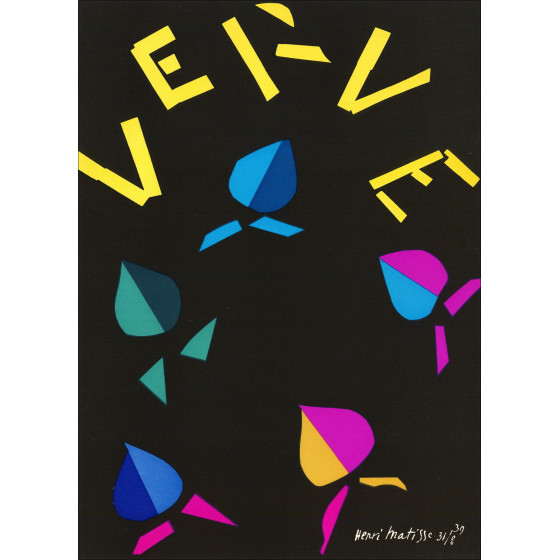
Matisse practised etching, drypoint, linocut and lithography, often for illustrated books. He also designed several covers and plates for the review Verve, published by Tériade and printed in lithography by Mourlot. After his death, his compositions were reinterpreted in lithography and screen printing, and his exhibitions gave rise to beautiful posters. These editions now make it possible to hang some of Matisse's most famous images at home at accessible prices.
Henri Matisse prices and market value: how much is a work worth?
Henri Matisse ranks among the very top names in the modern art market, and his market value ranges from colour lithographs to canvases worth tens of millions. The price depends on the nature of the work, its signature, the numbering of the edition, the period, the subject and the condition. As a guide, here are the ranges generally observed on the market, in galleries as well as at auctions:
- Colour lithographs published by Tériade, in Verve or after Jazz, and posters: from around €95 to €950, depending on the subject, format and edition.
- Signed and numbered lithographs, etchings and linocuts: from a few thousand to several tens of thousands of euros, more for the most famous subjects.
- Drawings: from several tens of thousands of euros to several million.
- Paintings and cut-out gouache papers: from several million to several tens of millions of euros.
Odalisques, nudes, faces in pure line and cut-paper compositions are the most sought after. For prints, the pencil signature and the numbering of the edition make all the difference compared with standard edition lithographs.
Buy a work by Henri Matisse
Looking for a signed Matisse lithograph or a fine edition for a first acquisition? The plates from Jazz and the lithographs from Verve offer the bold colours and cut-out forms that give the artist his distinctive charm. Above, the gallery presents a fine selection: Composition pour Verve printed by Mourlot in 1940, Le Clown from 1947, Femme au chapeau, several plates from Jazz published in 2005, such as Le Lanceur de couteaux, L'Avaleur de sabres, Le Destin or Cow-boy, as well as the screenprint Nu bleu II. Exhibition posters, such as Le lanceur de couteaux, are an excellent way to start a collection. Each work is shipped promptly, carefully protected, tracked and insured. Every work offered by the gallery is described in detail and sold with an invoice-certificate. To extend your discovery of the Fauves and their heirs, see also Georges Braque, Pierre Bonnard and Marc Chagall.
How much does a Matisse lithograph or screenprint cost?
Works available at the gallery range from €95 to €950. On the market, a signed and numbered print sells for anywhere from a few thousand to several tens of thousands of euros, drawings from several tens of thousands of euros, and paintings and cut-paper works for several million.
Who was Henri Matisse?
A French painter, draughtsman, printmaker and sculptor, Henri Matisse is the leading figure of Fauvism. Alongside Picasso, he is one of the two great innovators of twentieth-century painting, a master of pure colour and later of gouache-painted cut-outs.
What is the book Jazz?
Jazz is a book published in 1947 by the publisher Tériade. It brings together twenty plates printed in pochoir after Matisse's cut-paper works, accompanied by handwritten texts by the artist. Its images, such as Icare or Le Cirque, are among the most famous in modern art.
Where can you see works by Matisse?
The Musée Matisse in Nice, the Musée départemental Matisse in Le Cateau-Cambrésis, his birthplace, and the Chapelle du Rosaire in Vence, which he designed entirely, are the major venues dedicated to his work. The Centre Pompidou also holds a major ensemble of his work.
What is Henri Matisse's auction record?
Odalisque couchée aux magnolias, painted in 1923, was sold for $80.8 million at Christie's in New York in May 2018, during the sale of the Rockefeller collection. This result places Matisse among the most expensive modern artists in the world.
What is the difference between a plate from Jazz and an original lithograph?
The plates from Jazz of 1947 were printed in pochoir for Tériade's book. The coloured lithographs offered today are editions after these compositions, such as those from 2005. They capture the force of the cut-paper works at an accessible price, while prints signed and numbered in pencil command a different level of market value.
Appraisal, sale or purchase of a work by Matisse
Do you own a lithograph, a signed print, a drawing or a painting by Henri Matisse? Galerie 125 offers a confidential, no-obligation appraisal, based on in-depth knowledge of the market. Simply send detailed photographs, the dimensions, the signature and numbering, as well as the general condition of the work. Depending on the quality of the piece, an immediate purchase may be considered. Every request is handled with rigour and discretion.
Do you own a lithograph, an oil on canvas, a gouache or an original drawing by Henri Matisse and wish to sell it? Find out how to proceed on our page Sell a work.