DUFY Raoul
Raoul Dufy (1877-1953), a Fauvist painter who later developed a luminous style built on flat areas of colour and a lively line, celebrated regattas, orchestras and the Bay of Nice. Below you will find a fine selection of colour lithographs, prints and illustrated books after his compositions.
Raoul Dufy
The Painter of the Joy of Living
Painter, printmaker, illustrator, and designer of textiles and ceramics, Raoul Dufy (1877-1953) was the painter of light, the sea and celebration. His regattas, racecourses, orchestras and views of Nice and Deauville, painted with a lively line and colours laid in broad flat areas independent of the drawing, make him one of the most beloved artists in French art.
Biographical Milestones
1877Born on 3 June in Le Havre
1900Enters the École des Beaux-Arts in Paris on a scholarship
1905Inspired by Matisse's "Luxe, calme et volupté," he joins the Fauves
1911Woodcuts for Apollinaire's "Bestiaire."
1912–1928Textile designer for the house of Bianchini-Férier
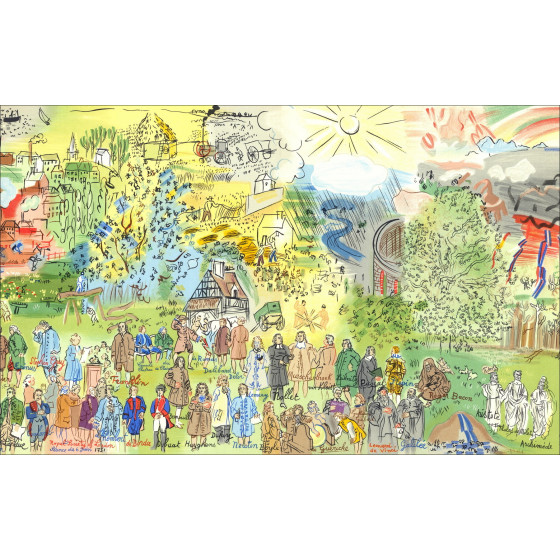
1937"La Fée Électricité," a monumental decorative work for the International Exhibition
1952Grand Prize for Painting at the Venice Biennale
1953Dies in Forcalquier on 23 March
The Career of Raoul Dufy
Le Havre and the Light of Normandy
Born in Le Havre into a large musical family, Raoul Dufy attended evening classes at the city's École des Beaux-Arts, alongside Georges Braque and Othon Friesz. The light of the estuary, the boats and the beaches of Normandy would mark his entire body of work. In 1900 he won a scholarship to study in Paris.
From Fauvism to a Personal Style
In 1905, faced with Henri Matisse's "Luxe, calme et volupté," Dufy adopted the pure colours of Fauvism. After a period close to Cézanne and Cubism, he found his own language: a quick, almost calligraphic drawing and colours in broad zones that spill beyond the contours, as if to convey the light bathing the objects.
The Printmaker and the Textile Designer
In 1911, Dufy cut the woodcut illustrations for Apollinaire's "Bestiaire ou Cortège d'Orphée," a masterpiece of the illustrated book. The couturier Paul Poiret commissioned him to create textiles, and for nearly twenty years he then designed for the Lyon silk house Bianchini-Férier. Flowers, birds, shells and exotic motifs made him one of the great textile designers of the century.
Regattas, Races and Music
In the 1920s and 1930s, Dufy painted elegant society life: regattas at Deauville and Cowes, racecourses at Epsom and Longchamp, the Promenade des Anglais in Nice, casinos, balls and receptions. A passionate lover of music, he also painted orchestras, violins and homages to Mozart, Bach and Debussy. In 1937 he created "La Fée Électricité," a 600-square-metre decoration for the Electricity Pavilion, now in the Musée d'Art Moderne in Paris. In 1952 he received the Grand Prize for Painting at the Venice Biennale.
Lithographs, Engravings and Posters
Dufy's graphic output is immense: woodcuts, lithographs, book illustrations such as Mallarmé's "Madrigaux" and "La Belle Enfant," and numerous lithographs published after his watercolours and gouaches. His exhibition posters and prints of regattas, races and musicians capture the freshness and joyfulness of his art. Many artists have paid tribute to him, among them Charles Lapicque and Jean Lurçat.
A Style Instantly Recognisable
At Dufy, colour and line each live a life of their own: a splash of blue or pink spills over the outline, while a nervous stroke, almost a handwriting, underlines the sailing boats, horses and musicians. This freedom, nourished by Fauvism and a constant taste for celebration, gives his scenes an immediately recognisable joyfulness.
Raoul Dufy Prices and Market Value: How Much Is a Work Worth?
Raoul Dufy is one of the French painters most prized by collectors, from colour lithographs to large watercolours and canvases. The price depends on the nature of the work, its signature, its numbering, its size, its subject and its condition. As a guide, here are the ranges generally seen on the market, both in galleries and at auctions:
- Colour lithographs after his works: approximately €60 to €400, a lovely way to bring the light and palette of Dufy into your home.
- Signed original prints, lithographs and woodcuts: from a few hundred to a few thousand euros.
- Watercolours and gouaches: from several thousand to several tens of thousands of euros.
- Paintings: from several tens of thousands of euros to several million.
Regattas, racecourses, orchestras, the Bay of Nice and interiors with open windows are the most sought-after subjects. For a lithograph, the freshness of the colours and the condition of the paper make all the difference.
Buying a Work by Raoul Dufy
Are you looking for a Dufy lithograph to bring light and joy into your interior? The gallery presents above its lithographs, prints and posters. Among the subjects on offer:
- Festive and leisure scenes: Régates, L'orchestre, Hommage à Jean Renoir, Marrakech.
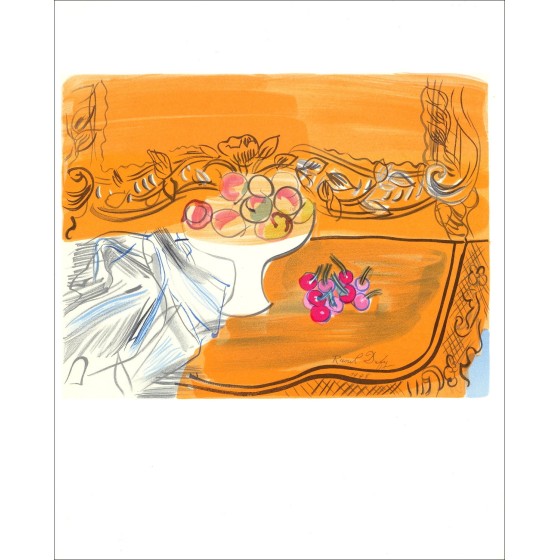
- Still lifes and decorative motifs: Nature morte aux fleurs, Nature morte aux fruits, Oiseaux sur fond bleu.
- "La Fée Électricité" and its studies: La fée électricité, Portrait de Isaac Newton.
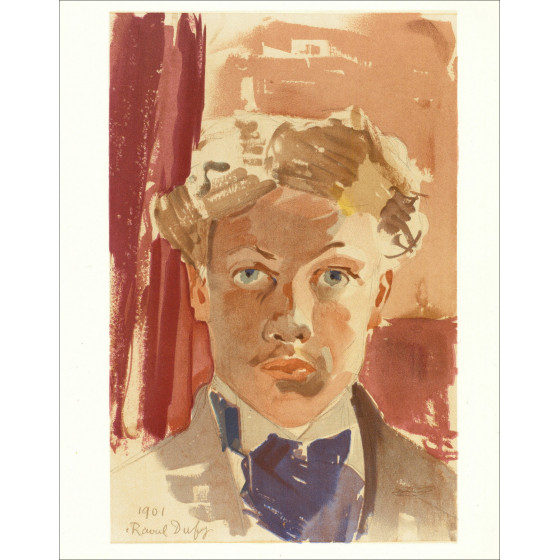
- Country scenes, portraits and an illustrated book: Travaux des champs, Autoportrait au fauteuil, the book Vacances forcées.
Order online: your work is shipped promptly, carefully protected, with tracking and insurance. Each work offered by the gallery is described precisely and sold with a certificate invoice. Other painters of light and the sea to discover: Eugène Boudin and André Hambourg.
Appraisal, Sale or Purchase of a Work by Raoul Dufy
Do you own a watercolour, a gouache, a drawing, a lithograph or a signed print by Raoul Dufy? Galerie 125 offers a confidential, no-obligation appraisal based on an in-depth knowledge of the market. Simply send detailed photographs, the dimensions, the signature, any numbering and the general condition. Depending on the quality of the piece, the gallery may consider purchasing it.
How much does a lithograph or painting by Raoul Dufy cost?
Expect to pay roughly €60 to €400 for a colour lithograph after his works, and from a few hundred to a few thousand euros for a signed original print. Watercolours and gouaches sell for several thousand to several tens of thousands of euros, and paintings for considerably more.
What is Raoul Dufy's auction record?
La Foire aux oignons, a Fauvist canvas from 1907, sold for £4.05 million at Sotheby's in London in February 2007, a record for the artist at that date. His lithographs, however, remain very affordable.
What does "La Fée Électricité" depict?
Created for the Electricity Pavilion at the 1937 International Exposition, this 600-square-metre mural traces the history of electricity, from the scientists who discovered it to the machines it powers. It is now held at the Musée d'Art Moderne de Paris, and certain lithographs reproduce its studies.
Why is Apollinaire's "Bestiary" mentioned?
Dufy's first major illustrated book, "Le Bestiaire ou Cortège d'Orphée" (1911), gathers his woodcut engravings, with their synthetic and vigorous line, set to poems by Guillaume Apollinaire. It revealed a gift for engraving that would shape all of his later work as an illustrator.
Did Dufy work in fashion and textiles?
Yes. Commissioned by Paul Poiret, and then employed for nearly twenty years by Bianchini-Férier in Lyon, he designed flowers, birds and exotic motifs for printed silks. This experience influenced his flat areas of colour and the decorative rhythm of his compositions.
How can I sell or get an appraisal for a work by Raoul Dufy?
Send Galerie 125 detailed photographs of the work, its dimensions, the signature, any numbering and its general condition. The appraisal is confidential and without obligation, and a purchase may be considered depending on the quality of the piece.
Do you own a lithograph, watercolour or original drawing by Raoul Dufy and wish to sell it? Find out how to proceed on our Sell a work page.