
CHAGALL Marc
Marc Chagall (1887-1985), painter of love and dreams and a leading figure of the School of Paris, is one of the great lithographers of the 20th century. Galerie 125 offers a number of original lithographs, including The Twelve Tribes of Israel from 1962 (Draeger Frères), as well as exhibition posters printed at Mourlot, just a few kilometres from the stained-glass windows of Metz Cathedral. Discover the selection below.


- -€100.00
- Out of stock


Marc Chagall
The Poet of Colour
Painter, printmaker, lithographer, ceramicist and stained-glass designer, Marc Chagall (1887-1985) is one of the most beloved artists of the 20th century. Born in a small town in present-day Belarus, he turned his childhood memories, love, the Bible and the circus into a dreamlike world where lovers take flight, fiddlers float above the rooftops and animals dream. An exceptional lithographer, he left behind a vast body of printed work that is highly sought after by collectors.
Biographical Milestones
1887Born on 7 July in Vitebsk
1910First stay in Paris, at La Ruche
1915Marries Bella Rosenfeld, his muse
1923Settles in France at the invitation of the dealer Ambroise Vollard
1941–1948Exile in the United States
1958–1968Stained-glass windows for Saint-Étienne Cathedral in Metz
1964Ceiling of the Palais Garnier opera house
1973Inauguration of the Musée national Message biblique Marc Chagall in Nice
1985Dies on 28 March in Saint-Paul-de-Vence
The Career of Marc Chagall
Vitebsk, the Source of Everything
The eldest of nine children in a modest Jewish family, Chagall grew up in Vitebsk, in a world of Hasidic traditions, musicians, rabbis and small wooden houses. He studied painting in Vitebsk and then in Saint Petersburg. Throughout his life he would return to these childhood images: the fiddler on the roof, the cow, the rooster, the snow-covered villages, which became the symbols of his work.
Paris and La Ruche
In 1910, Chagall arrived in Paris. Settled at La Ruche, he mixed with Fernand Léger, Michel Kikoïne, Chaïm Soutine and the poets Blaise Cendrars and Guillaume Apollinaire. Through his contact with Cubism and Fauvism, he invented a personal, free and colourful language in which the laws of gravity no longer applied. His masterpieces from this period, such as I and the Village, are today held in the greatest museums.
Revolution, Exile and Return
Returning to Russia in 1914, he married Bella, founded an art school in Vitebsk, and then left his country for good in 1922. Settled in France at the invitation of Ambroise Vollard, who commissioned from him the engravings for Gogol's Dead Souls, La Fontaine's Fables and the Bible, he became one of the great painters of the School of Paris. Taking refuge in the United States during the war, he lost Bella there in 1944. He returned to France in 1948 and settled in the South, in Vence and then in Saint-Paul-de-Vence.
Stained Glass, Mosaics and Large-Scale Decorations: Chagall and Metz
From the 1950s onwards, Chagall turned to large-scale decorative commissions. He created stained-glass windows for numerous religious buildings, including Saint-Étienne Cathedral in Metz, where he produced a set of luminous windows between 1958 and 1968: one more reason for enthusiasts of Moselle and Lorraine to take an interest in his work. He also designed the stained-glass windows of the synagogue of the Hadassah hospital in Jerusalem, dedicated to the twelve tribes of Israel, the ceiling of the Palais Garnier in 1964, the paintings for the Metropolitan Opera in New York, as well as mosaics, tapestries and ceramics.
The Lithographer
Chagall is one of the greatest lithographers of the 20th century. From 1950 onwards, he worked with the Mourlot workshop in Paris, alongside the lithographer Charles Sorlier, and produced more than a thousand lithographs, often in colour. He illustrated major books such as Daphnis et Chloé, Le Cirque and La Bible, and created lithographs for the magazine Verve and for Derrière le Miroir, the review of the Maeght gallery. His exhibition posters, for the Bibliothèque nationale, the museum in Nice or La Ruche et Montparnasse, have become collectors' pieces. The book Vitraux pour Jérusalem, published in 1962, reproduces in lithography the twelve stained-glass windows of the tribes of Israel.
A universe of colour and poetry
In Chagall's work, colour does not imitate reality: it expresses emotion. Lovers floating above villages, bouquets, musicians, circus scenes and biblical subjects compose a world of poetry where dream and memory intermingle. This language, instantly recognisable, has made him one of the most popular artists of the 20th century.
Marc Chagall prices and market value: how much is a work worth?
The price depends first on the nature of the work (published lithograph, signed print, gouache or canvas), then on the signature, the numbering, the subject, the size and the condition. As a guide, here are the ranges generally seen on the market:
- Colour lithographs, such as the series Douze tribus d'Israël (1962, Draeger Frères): roughly €125 to €500, a fine entry point into Chagall's universe.
- Exhibition posters printed by Mourlot: roughly €150 to €350, considerably more when signed.
- Signed and numbered original lithographs and engravings: from a few thousand to several tens of thousands of euros, depending on the subject, the edition size and the rarity.
- Drawings, gouaches and watercolours: from a few tens of thousands to several hundred thousand euros.
- Paintings: from several hundred thousand euros to several million.
Lovers, bouquets, the circus, musicians and memories of Vitebsk are the most sought-after subjects. For prints, a pencil signature, a limited edition and well-preserved colours make all the difference.
Buy a lithograph by Marc Chagall
Are you looking for a signed Chagall lithograph or a quality exhibition poster? The gallery presents above a fine selection of lithographs:
- The tribes of Israel of 1962 (Draeger Frères), including Juda, Issachar, Siméon, Levi, Gad, Zabolon, Nephtali and Benjamin.
- The original lithographs Tables de la Loi (1962), Composition (1965) and Nativité (1950).
- Exhibition posters: Bibliothèque nationale (1957), musée national de Nice (1974) and La Ruche et Montparnasse.
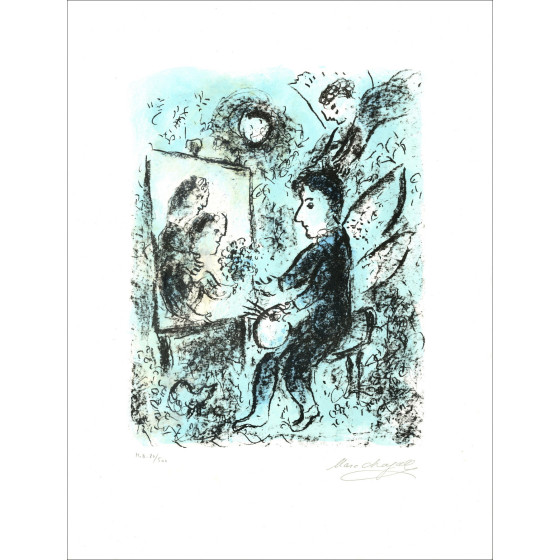
Some pieces have already found a buyer, such as Vers l'autre Clarté, the artist's last lithograph (1985): check the page as new acquisitions come in. You can order online or come and see the works by appointment at the gallery, near Metz and its stained-glass windows. Careful, tracked and insured shipping. Every work offered by the gallery is described in detail and sold with an invoice-certificate. Also worth discovering: Joan Miró, Pablo Picasso and Marie Laurencin.
How much does a Marc Chagall lithograph or painting cost?
A colour lithograph or exhibition poster can be acquired from €125. A signed and numbered original print ranges from a few thousand to several tens of thousands of euros, a drawing or gouache reaches several tens of thousands of euros, and a painting exceeds several hundred thousand euros.
Who was Marc Chagall?
Marc Chagall (1887-1985) was a painter, printmaker and stained-glass designer, born in Vitebsk, in present-day Belarus, and naturalised French. A major figure of the School of Paris, he painted love, dreams, music and memories of his native village in luminous, poetic colour.
Where can I see Chagall stained-glass windows near Metz?
Metz Cathedral (Saint-Étienne) houses several Chagall windows, created between 1958 and 1968 with the Simon-Marq workshop of Reims. In the Moselle department, the Chapelle des Cordeliers in Sarrebourg holds its large stained-glass window La Paix. Reims Cathedral and the Church of Saint-Étienne in Mainz, Germany, also have remarkable ensembles.
What is a Mourlot Chagall lithograph?
From 1950 onwards, Chagall produced the bulk of his lithographic work at Fernand Mourlot's workshop in Paris. His original lithographs were printed there with exceptional care, in highly rich colours.
Where can I see Chagall's works in France?
The Musée national Marc Chagall in Nice, inaugurated in 1973, presents his large Biblical Message cycle. The Centre Pompidou in Paris holds several of his major canvases, and the Opéra Garnier its famous ceiling painted in 1964.
What is Marc Chagall's auction record?
His canvas Les Amoureux, painted in 1928, was sold for $28.5 million at Sotheby's in New York in November 2017, a record for the artist at that date. This result illustrates Chagall's place at the top of the market, while his lithographs remain accessible to a wide range of collectors.
Appraisal, sale or purchase of a Marc Chagall work
Do you own an original lithograph, a signed print, a gouache, a drawing or an oil by Marc Chagall? Galerie 125 offers a confidential, no-obligation appraisal, based on a thorough knowledge of the market. Simply send detailed photographs, the dimensions, the signature and numbering, as well as the general condition of the work. Depending on the quality of the piece, a purchase may be considered. Each request is handled with rigour and discretion.
Do you own an original lithograph, gouache or drawing by Marc Chagall and wish to sell it? Find out how to proceed on our page Sell a work.