SOUTINE Chaïm
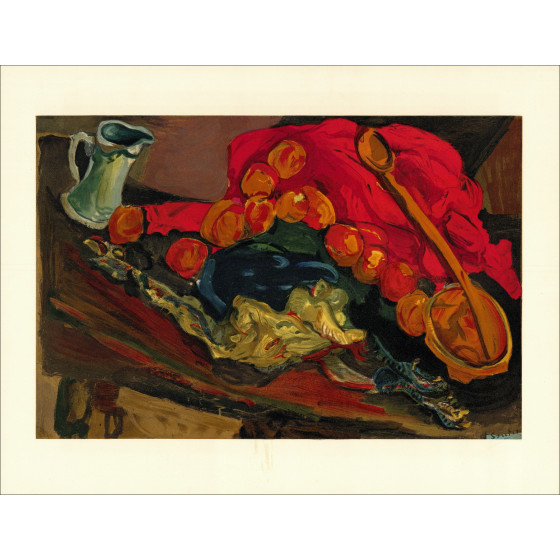
Chaïm Soutine (1893-1943), a painter of the École de Paris and a leading figure of expressionism, painted the turbulent landscapes of Céret, carcasses of beef and portraits of bellboys. The gallery currently offers his lithograph Nature morte à la dinde, printed by Mourlot, below.
Chaïm Soutine
Painting as a Fever
Chaïm Soutine (1893-1943) is counted among the greatest painters of the École de Paris and among the fathers of modern expressionism. His landscapes of Céret, his carcasses of beef, his poultry and his portraits of bellboys and pastry chefs, set in thick impasto and blazing colours, left a profound mark on twentieth-century painting.
From Smilavichy to Paris: Soutine's Journey
Chaïm Soutine was born in 1893 in Smilavichy, near Minsk, into a poor Jewish family. He studied drawing in Minsk and then in Vilnius before making his way to Paris in 1913. At La Ruche, and later in Montparnasse, he lived in great poverty alongside Marc Chagall and Michel Kikoïne. His friend Amedeo Modigliani introduced him to the dealer Léopold Zborowski, who sent him to paint in the South of France.
From 1919 to 1922, in Céret, in the Pyrénées-Orientales, he painted landscapes that seem to whirl. In 1922, the American collector Albert Barnes bought a large part of his canvases: Soutine became famous overnight. During the Occupation, he had to go into hiding. He died in Paris on 9 August 1943 from the complications of an ulcer.
Soutine's Style: Matter, Colour and Subjects
In Soutine's work, paint seems alive. He worked quickly, as if in a trance, with thick impasto and saturated colours: blood reds, deep blues, acid greens. Forms twist, faces become distorted, trees and houses waver. Yet this apparent violence goes hand in hand with a deep love of the Old Masters: he spent hours at the Louvre in front of Rembrandt, Chardin or Courbet, from whom he retained the power of matter and a respect for the humblest subject.
Demanding to the point of obsession, he often destroyed his own canvases when they failed to satisfy him. His influence on the American Abstract Expressionists, from de Kooning to Pollock, was considerable.
Chaïm Soutine at Galerie 125
Soutine did not make engravings: lithographs after his paintings, notably those printed by Mourlot, allow you to live with the force of his still lifes. The gallery currently offers the lithograph Nature morte à la dinde, after one of his celebrated still lifes of poultry, above. It is shipped with care, by tracked and insured delivery, together with the gallery's certificate.
Also worth discovering are other painters of the École de Paris: Moïse Kisling, Mané-Katz and Jules Pascin. The gallery also welcomes visitors in Argancy, near Metz, by appointment.
Why is Soutine associated with expressionism?
His tormented brushwork, saturated colours and distorted forms convey raw emotion rather than faithful description, which links him to the expressionists, although his work remains unique.
Why did he paint carcasses of beef?
Inspired by Rembrandt's Flayed Ox, he made the carcass a recurring motif, a pretext for a fleshy, red and vibrant painting.
Which Soutine lithograph does the gallery offer?
The gallery offers Nature morte à la dinde, a lithograph printed by Mourlot after one of his still lifes of poultry, in the format 50 x 65 cm.