

Shepard Fairey reimagines Marilyn Monroe with "Marilyn Sunrise" and "Marilyn Sunset".
Two new screen prints by Shepard Fairey (OBEY) are joining Gallery 125: "Marilyn Sunrise" and "Marilyn Sunset", two portraits of Marilyn Monroe created in 2026.
With these new creations, the American artist is tackling one of the most famous faces of the 20th century. But instead of simply reproducing Marilyn's glamorous image, Shepard Fairey seeks to show a more complex personality, blending confidence and vulnerability.
Two works designed as a true duo, with the same color palette and two different attitudes of Marilyn Monroe.
Shepard Fairey meets a Pop Art icon
Marilyn Monroe has long held a special place in the history of contemporary art and popular culture.
Her face has become a true icon, notably thanks to the famous portraits created by Andy Warhol in the 1960s. Shepard Fairey is obviously aware of this legacy and explains that he discovered Warhol's Marilyn portraits himself when he became interested in Pop Art during his youth.
For this new series, the artist OBEY chooses a different direction.
Where Warhol worked on repetition, contrasts, and the transformation of Marilyn into a popular icon, Shepard Fairey seeks to find more intimacy and humanity here.
Artworks inspired by the photographs of Milton H. Greene
To create "Marilyn Sunrise" and "Marilyn Sunset", Shepard Fairey relied on photographs of Marilyn Monroe Taken by the American photographer Milton H. Greene in 1956, when the actress was at the peak of her career.
Fairey explains that he was particularly sensitive to the intimacy and vulnerability that emanate from these photographs.
He therefore chooses a more delicate graphical approach than in some of his usual portraits.
The result remains immediately identifiable as an OBEY creation: flat colors, strong outlines, simplified volumes, and deliberately limited palette. However, the pastel tones and the softness of the blue, pink, and green bring an unusual atmosphere to these two screen prints in his work.
"Marilyn Sunrise": a luminous Marilyn
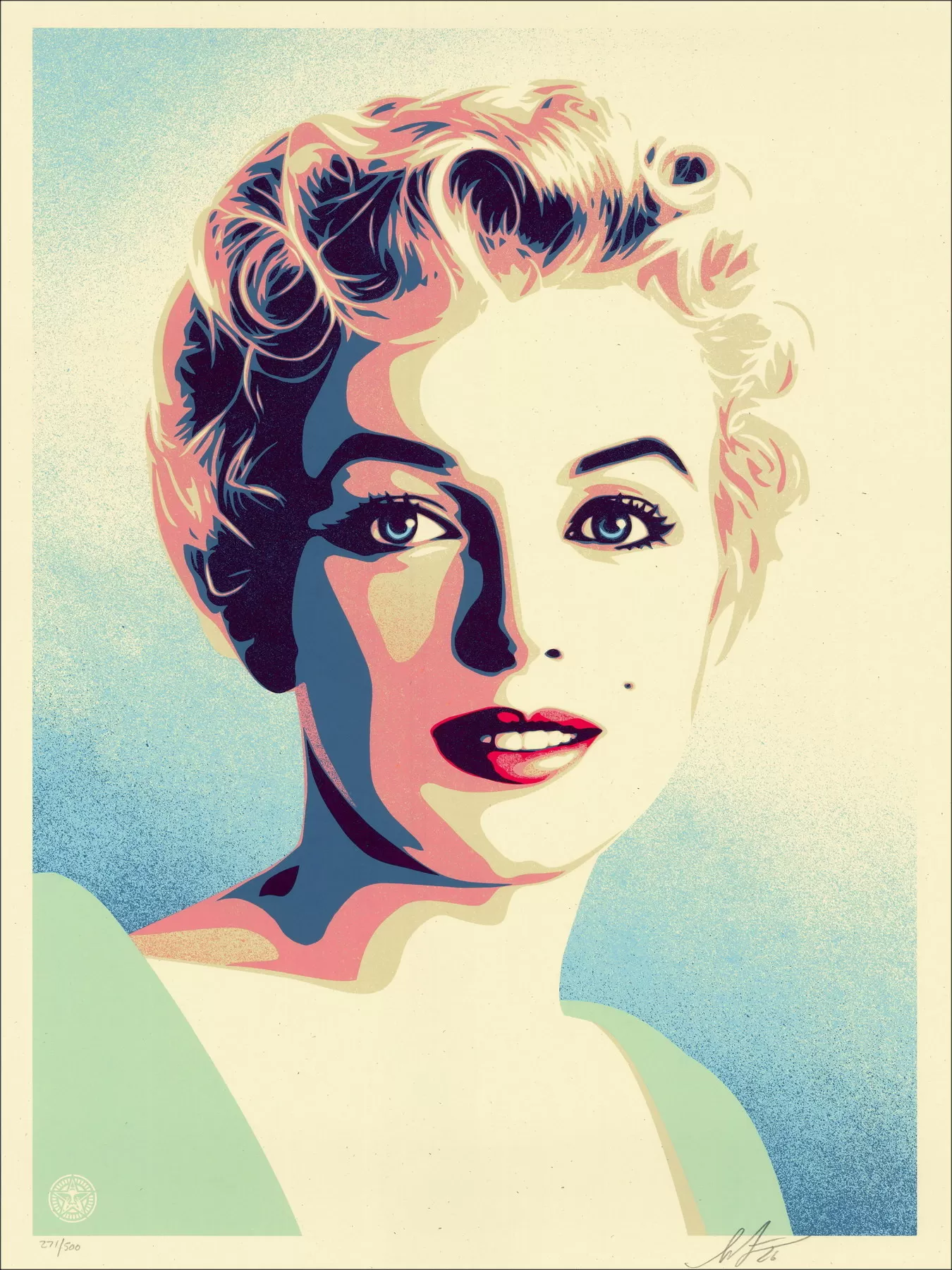
In "Marilyn Sunrise", Marilyn appears with her face slightly turned, her gaze open towards the viewer.
The composition is particularly luminous. Cream tones cover a large part of the face, while shades of pink, blue, and green gradually build the volumes.
Shepard Fairey retains enough details for Marilyn to be immediately recognizable, but transforms her portrait according to his own graphic language.
The image has something very soft, almost optimistic, which perfectly explains the choice of the title Sunrise, the rising of the sun.
"« Marilyn Sunset »: a more introspective atmosphere"
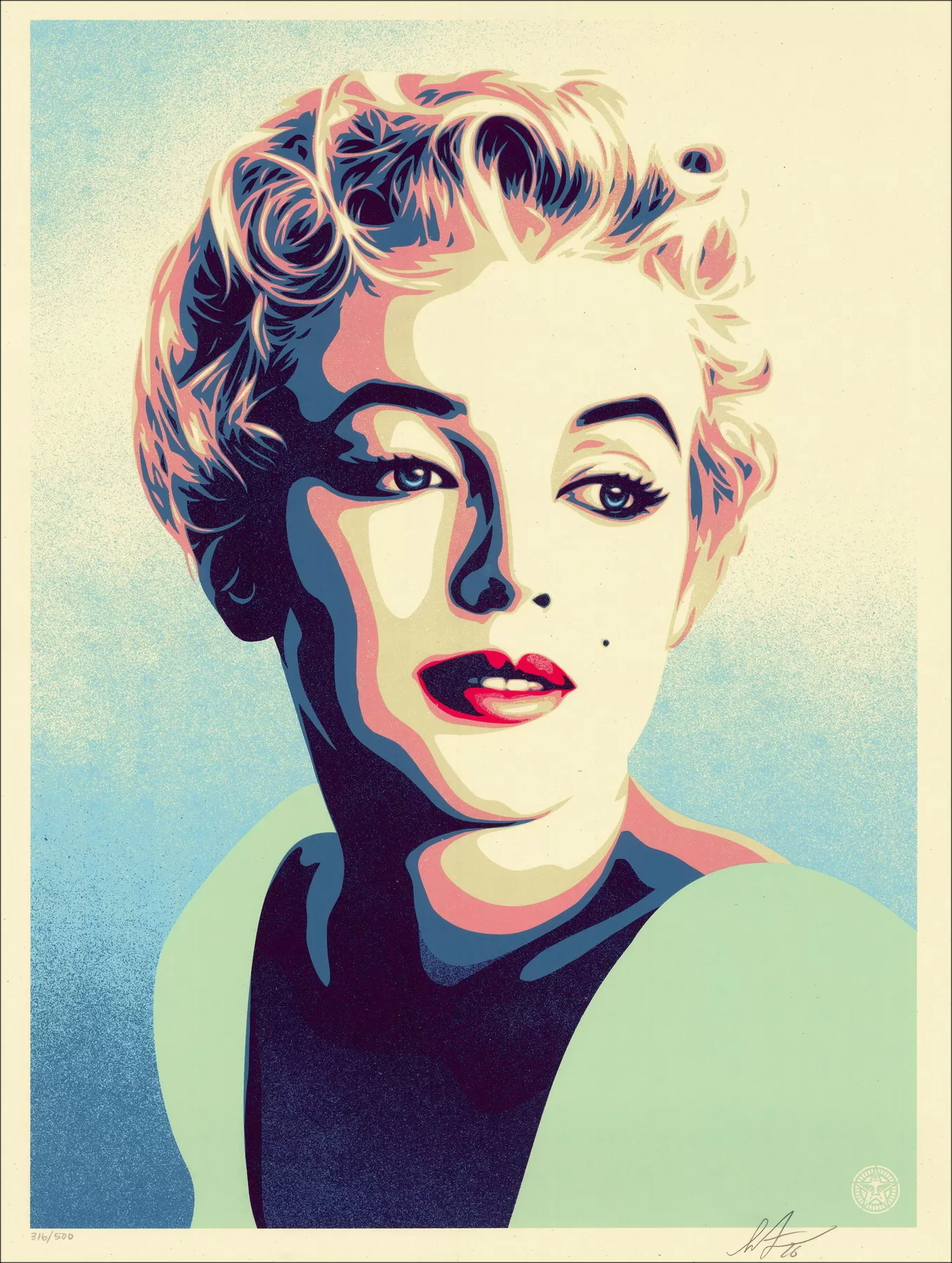
"Marilyn Sunset" uses the same color palette but offers a noticeably different attitude.
The face is more frontal and the gaze appears more reserved. Dark areas also play a more prominent role in the composition, especially around the face and neck.
Presented side by side, the two works then take on their full meaning.
Shepard Fairey wanted to evoke precisely this duality in Marilyn Monroe: a personality capable of embodying both strength, glamour, and hope, but also a certain vulnerability. The artist describes the two images as a reflection on this balance between strength and fragility.
Two screen prints designed as a diptych
Marilyn Sunrise and Marilyn Sunset can naturally be presented separately, but their combination is particularly successful.
Both works have exactly the same format of 61 × 46 cm (24 × 18 inches) and use a common color palette.
The gaze, facial expression, and distribution of shadows change, creating a dialogue between the two portraits.
During their release, OBEY also offered a limited number of sets bearing corresponding numbers, confirming that Shepard Fairey had also envisioned the two creations as a pair.
Original screen prints signed and numbered up to 500 copies
Both works were created using silkscreen printing on Speckletone cream paper.
Each edition is limited to 500 copies, numbered and signed by Shepard Fairey. The two screen prints were officially released on May 14, 2026.
The choice of cream-colored paper plays a key role in the rendering of the artwork. It softens the colors and pairs particularly well with the pastel palette chosen for these portraits.
From Warhol to OBEY: Marilyn Monroe always reinvented
These two screen prints are also interesting because of the dialogue they create between Pop Art and Street Art.
Andy Warhol had helped transform Marilyn Monroe into one of the great icons of Pop Art. More than sixty years later, Shepard Fairey in turn takes up this universally known face with the graphic codes derived from his own journey in Street Art, posters, and the OBEY culture.
But Fairey is not trying to reproduce Warhol. On the contrary, he claims a different approach, aimed at showing more nuances and humanity behind the icon.
It is this meeting between Marilyn Monroe, Pop Art, Street Art, and the OBEY universe that gives a particular dimension to these two editions of 2026.
Marilyn Sunrise and Marilyn Sunset available at Gallery 125.
With "Marilyn Sunrise" and "Marilyn Sunset", Shepard Fairey adds two new portraits to his extensive silkscreen work and offers his own interpretation of one of the most depicted personalities in the history of popular culture.
Two original screen prints by Shepard Fairey, signed and numbered out of 500 copies, which can be appreciated individually but fully reveal their complementarity when brought together.
"Marilyn Sunrise" and "Marilyn Sunset" by Shepard Fairey (OBEY), created in 2026 in the size of 61 × 46 cm, are now available at Galerie 125.