
TOULOUSE-LAUTREC Henri
Henri de Toulouse-Lautrec (1864-1901) revolutionized the poster and immortalized Parisian nightlife: Moulin Rouge dancers, singers, and café-concerts. Browse the lithographs above inspired by his work.



Toulouse-Lautrec, the Aristocrat Who Brought Montmartre to the Museums
One evening in 1891, Parisians encountered a poster unlike any they'd seen before: the black silhouette of Valentin le Désossé in the foreground, La Goulue's swirling skirts, bold color blocks, and the words "Moulin Rouge" in large letters. Its creator, a 26-year-old aristocrat from Albi, had just invented the modern poster. In a career spanning barely two decades, Henri de Toulouse-Lautrec became the chronicler of the Belle Époque and one of the greatest lithographers of all time.
- 1864: Born in Albi, November 24, into a high aristocracy family.
- 1878-1879: Two leg fractures, which then stop growing.
- 1882: Arrives in Paris, studies under Léon Bonnat then Fernand Cormon.
- 1884: Moves to Montmartre.
- 1891: First poster, Moulin Rouge, La Goulue.
- 1892-1893: Posters Divan japonais, Aristide Bruant, and Jane Avril.
- 1896: Publishes the lithographic album Elles.
- 1899: Hospitalized in a Neuilly clinic, draws the Cirque series from memory.
- 1901: Dies at Château de Malromé, Gironde, on September 9.
- 1922: Opening of the Toulouse-Lautrec Museum in Albi.
From Albi to Montmartre
Son of Count Alphonse de Toulouse-Lautrec, Henri grew up between Albi and family châteaux, in a world of hunting and horses. A hereditary bone disease and two fractures during adolescence halted his growth. Deprived of his favorite activities, he turned to drawing. In Paris, he studied under Léon Bonnat and then Fernand Cormon, where he met Émile Bernard and Vincent van Gogh. In 1884, he settled in Montmartre, which became his lifelong home.
The Chronicler of Nightlife
At the Moulin Rouge, Divan japonais, Mirliton, or Cirque Fernando, Toulouse-Lautrec tirelessly sketched dancers, singers, clowns, and night owls: La Goulue, Valentin le Désossé, Jane Avril, Yvette Guilbert, Aristide Bruant, and the clowness Cha-U-Kao. An admirer of Edgar Degas and Japanese prints, he framed his scenes boldly, cropped figures at the image's edge, simplified forms, and played with large color blocks. He also painted, with tender impartiality, the daily life of brothels, where he sometimes stayed for weeks.
The Master of the Poster
After Moulin Rouge, La Goulue, came a succession of posters: Divan japonais, Aristide Bruant in his cabaret, Jane Avril at Jardin de Paris, La Chaîne Simpson, La Revue blanche. With just thirty-one posters, Toulouse-Lautrec transformed this advertising medium into a standalone art form. His compositions, readable from afar and of unmatched graphic elegance, influenced generations of poster artists and graphic designers.
The Lithographer
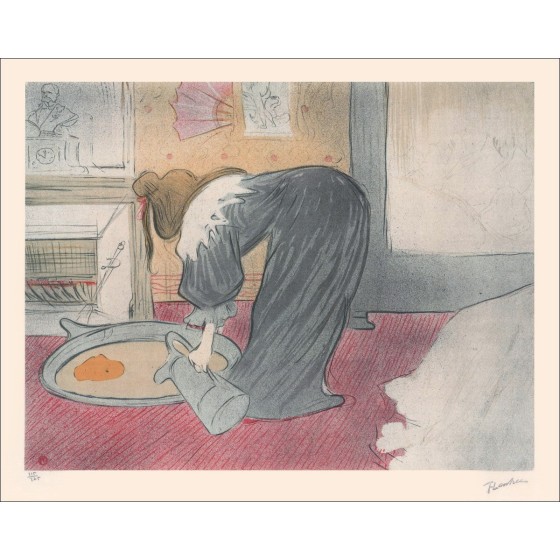
Even more than posters, color lithography was his experimental playground. He created over three hundred prints, working directly on stone with the finest printers of his time, including Auguste Clot, mastering the crachis technique, those fine ink sprays that add depth and vibrancy. In 1896, publisher Gustave Pellet released Elles, a lithographic album capturing the intimate lives of brothel women in their simplest gestures: washing, waking, combing, mirroring. Exhausted by alcohol and illness, Toulouse-Lautrec died at thirty-six. His mother donated much of his work to the city of Albi, which opened a museum in his honor in 1922.
Choosing the Right Toulouse-Lautrec Artwork
- His lithographs based on famous posters like Moulin Rouge, La Goulue, Divan japonais, or La Chaîne Simpson let you live with his most iconic images.
- The plates inspired by the Elles series captivate with their intimacy and delicacy.
- Posters from his major exhibitions, such as the 1964 centenary, are prized collector's items.
- Each piece offered by the gallery is meticulously described and sold with an invoice-certificate.
Henri de Toulouse-Lautrec: Artwork Prices and Market Value
Henri de Toulouse-Lautrec holds a unique position in the market, bridging painting and poster art, which he elevated to a standalone art form. Prices depend primarily on the artwork's status—original from the period or later edition—followed by subject, edition, margins, and condition. As a guide, here are the typical price ranges observed in galleries and public sales:
- Lithographs after his works, book plates, and later editions: from a few tens to several hundred euros.
- Original lithographs printed during his lifetime: from a few thousand to several tens of thousands of euros.
- Original posters from 1891 to 1900: from a few thousand to several hundred thousand euros for the most famous.
- Drawings: from several tens to several hundred thousand euros.
- Paintings: from several hundred thousand euros to several million.
Moulin Rouge, Aristide Bruant, Jane Avril, Yvette Guilbert, and the cabaret world are the most sought-after subjects. For a poster or lithograph, it's crucial to know if it's a period edition or a later print.
How Many Posters Did Toulouse-Lautrec Create?
Henri de Toulouse-Lautrec (1864-1901) created only about thirty posters between 1891 and 1900. Yet, Moulin Rouge, La Goulue, Divan japonais, and Aristide Bruant were enough to establish him as the father of modern poster art.
Why Was Toulouse-Lautrec Short in Stature?
Due to a hereditary bone disease, he fractured both legs in adolescence, which then stopped growing. Deprived of the sporting life of his aristocratic milieu, he devoted himself to drawing, which became his passion.
Where to See Toulouse-Lautrec's Works?
The Toulouse-Lautrec Museum in Albi, housed in the Palais de la Berbie, holds the largest collection of his works, thanks to a family donation. In Paris, the Musée d'Orsay displays several of his major paintings.
What Is Toulouse-Lautrec's Auction Record?
La Blanchisseuse, painted around 1886-1887, was sold for 22.4 million dollars at Christie's in New York in November 2005, setting a record for the artist at that time.
Toulouse-Lautrec at Galerie 125
The gallery offers a wide selection of lithographs above: La Grande Loge, Femme au miroir, La Toilette, Femme se coiffant, Conquête de passage, Au Moulin-Rouge, Moulin-Rouge, La Goulue, Divan japonais, La Chaîne Simpson, Promenade de la vache enragée, and Elles: Femme au tub. Also available are exhibition posters from the Musée d'Art Moderne de Paris, Galerie 65 in Cannes, and the 1964 centenary. Reserve your artwork online: it ships quickly, carefully packed, with tracked and insured delivery, and the gallery's certificate. Discover other Belle Époque artists: Auguste Renoir and Jacques Villon, who also began as a poster artist. Explore our selection of lithographs and engravings.
Do you own a work by Henri de Toulouse-Lautrec and wish to sell it? Learn how on our Sell an Artwork page.