
VILLON Jacques
Jacques Villon (1875-1963), brother of Marcel Duchamp, a leading figure of Cubism and a master of printmaking, designed the stained glass windows of the Metz Cathedral. Discover below his original lithographs and posters.


Jacques Villon
The Cubist of Light, from Newspapers to the Stained Glass of Metz
Beneath the vaults of the Saint-Étienne Cathedral in Metz, a few steps from the stained-glass windows of Marc Chagall, a chapel is bathed in soft, colourful light: these are the stained-glass windows by Jacques Villon, installed in 1957. Their creator, born Gaston Duchamp and the elder brother of Marcel Duchamp, had an extraordinary career. A caricaturist for more than ten years, he became one of the great figures of Cubism, then one of the masters of 20th-century printmaking, before a late but brilliant recognition.
Biographical Landmarks
1875Birth of Gaston Duchamp in Damville, Eure, on 31 July
1894Moves to Paris, where he takes the name Jacques Villon
1894–1906Illustrator for humorous magazines and poster artist
1911–1912Gathers the artists of the Section d'or at Puteaux
1920sNumerous colour engravings after the modern masters
1950Carnegie Prize, Pittsburgh
1956Grand Prize for Painting at the Venice Biennale
1957Stained-glass windows for the Saint-Étienne Cathedral in Metz
1963Dies in Puteaux, on 9 June
The Career of Jacques Villon
A Family of Artists
Born in Normandy into a family of notaries passionate about art, Gaston Duchamp was the eldest of an exceptional brood: his brothers Raymond Duchamp-Villon, a sculptor, and Marcel Duchamp, the inventor of the readymade, as well as his sister Suzanne, all became artists. Arriving in Paris in 1894, he adopted the pseudonym Jacques Villon, in homage to the poet François Villon. For about a dozen years, he drew for humorous magazines and produced posters. His first colour prints, influenced by Edgar Degas and Henri de Toulouse-Lautrec, already revealed a first-rate printmaker.
Puteaux and the Section d'or
Around 1910, Villon turned to painting and discovered Cubism. In his studio in Puteaux, he gathered his brothers and many other artists every Sunday, among them Albert Gleizes, Francis Picabia, Fernand Léger and Jean Metzinger. From these meetings came, in 1912, the Section d'or exhibition, which championed a Cubism founded on geometry, the golden ratio and colour, brighter than that of Picasso and Braque. His painting, built from transparent planes of colour that fit together like prisms, would always retain this rigour.
The Printmaker
Between the wars, Villon earned much of his living from printmaking. He produced numerous coloured etchings and aquatints after the great modern masters, Picasso, Matisse, Braque or Modigliani, with remarkable fidelity. He never stopped engraving his own compositions as well: portraits, landscapes and Cubist subjects. His printed oeuvre, comprising several hundred plates, makes him one of the greatest printmakers of the 20th century.
Recognition and the Stained Glass of Metz
Recognition came late, but it was dazzling: the Carnegie Prize in 1950, then the Grand Prize for Painting at the Venice Biennale in 1956. The following year, he produced stained-glass windows for the Cathedral of Saint-Étienne in Metz, one of the most luminous in France. His compositions, devoted in particular to the Last Supper and the Crucifixion, launched a vast programme of modern stained glass later continued by Marc Chagall and Roger Bissière. One more reason for lovers of art from Lorraine to take an interest in this artist, tied to the history of Metz.
A Sensitive and Luminous Geometry
In Villon's work, Cubism never freezes the subject: it breaks it down into light, almost transparent, coloured facets. Portraits, musicians, landscapes and still lifes are built through interlocking planes, with a clear palette dominated by blues, pinks and ochres. This mastery of composition, informed by the golden ratio, can be found in his paintings as well as in his lithographs.
Jacques Villon Prices and Market Value: How Much Is a Work Worth?
The value of a Villon work depends on its technique, format, subject, condition and edition. Here are the market's approximate price ranges.
- Small-format posters and lithographs: approximately €75 to €200.
- Large-format original lithographs and colour engravings: from a few hundred euros up to approximately €1,500.
- Drawings and watercolours: from €1,500 to several thousand euros.
- Cubist paintings: tens of thousands of euros, and more for major canvases.
An original lithograph is printed from a stone drawn by the artist himself, whereas a reproduction merely photographs an existing work. Among Villon's works, the proofs printed by Mourlot are among the most sought after.
Buying a Work by Jacques Villon
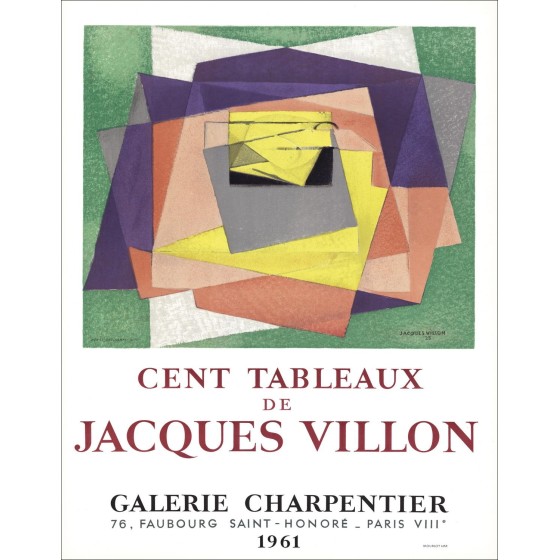
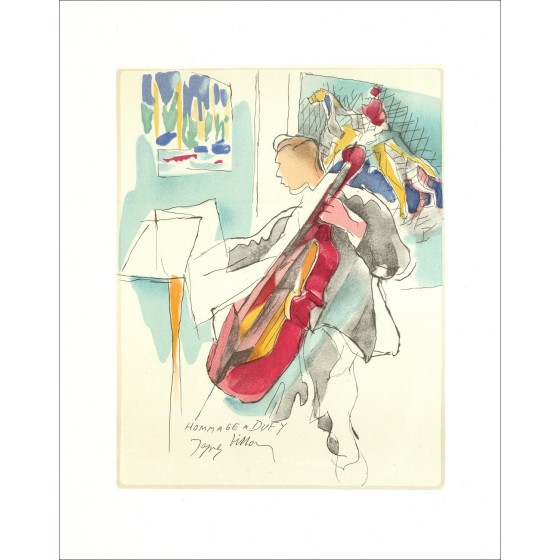
Are you looking for a signed Villon lithograph or an exhibition poster? The gallery currently presents above the poster France, Lorraine, Metz, vitraux de la cathédrale, devoted to his stained-glass windows in Metz. Also available are the lithograph Composition, printed by Mourlot in 1961, L'Homme et la couleuvre, from 1961, Le Violoncelliste, from 1965, and the poster for his exhibition at the Galerie Charpentier. Jacques Villon works currently available at the gallery range from €75 to €195. Each work is carefully described and sold with a certificate invoice. They can be ordered online and shipped with care by tracked and insured delivery, or viewed by appointment at our art gallery near Metz, a few minutes from the cathedral.
Also worth discovering, in the spirit of Cubism: André Lhote and Fernand Léger.
How Much Does a Jacques Villon Lithograph or Poster Cost?
Jacques Villon works currently available at the gallery range from €75 to €195. Large formats, drawings, watercolours and paintings reach markedly higher levels.
Why Is Jacques Villon Called That?
Born Gaston Duchamp, he adopted the pseudonym Jacques Villon in 1894, on arriving in Paris, as a tribute to the poet François Villon. This also avoided any confusion with his brothers, who were artists too.
What Was Jacques Villon's Relationship with Marcel Duchamp?
Marcel Duchamp, inventor of the readymade, was his younger brother. Their brother Raymond Duchamp-Villon was a sculptor and their sister Suzanne a painter. All of them frequented the Puteaux studio.
What Is the Section d'Or?
It is a group of Cubist artists gathered around Jacques Villon in Puteaux. Its 1912 exhibition in Paris championed a Cubism founded on geometry, the golden ratio and colour.
What Do Jacques Villon's Stained-Glass Windows in Metz Depict?
Installed in 1957 in the Cathedral of Saint-Étienne in Metz, they depict in particular the Last Supper and the Crucifixion. They mark the beginning of a modern stained-glass programme later continued by Marc Chagall and Roger Bissière.
What Distinguishes His Interpretive Prints?
In the 1920s, Villon engraved in colour, with great fidelity, paintings by Picasso, Matisse, Braque and Modigliani. These interpretive plates, often numbered, are highly prized by print enthusiasts today.
Do you own an oil on canvas, a watercolour or an original drawing by Jacques Villon and wish to sell it? Discover how to proceed on our Sell a Work page.