
VASARELY Victor
Checkerboards, spheres, and cubes that vibrate under the gaze: Victor Vasarely (1906-1997) invented op art. Discover his screenprints and works above, as they arrive.
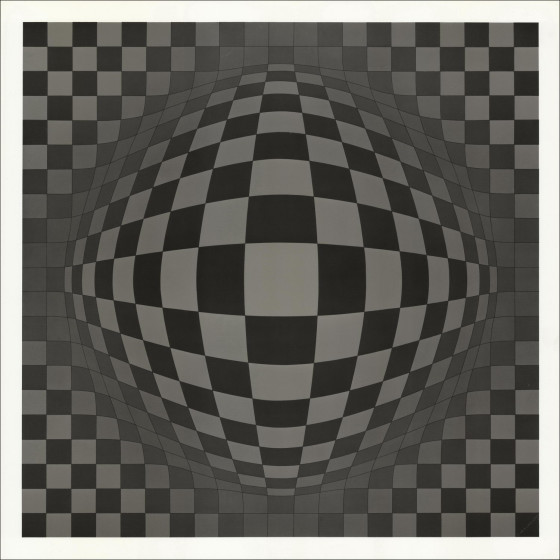
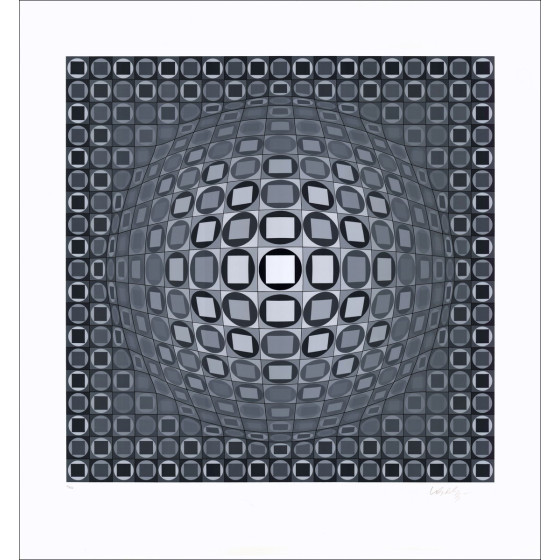
- Out of stock
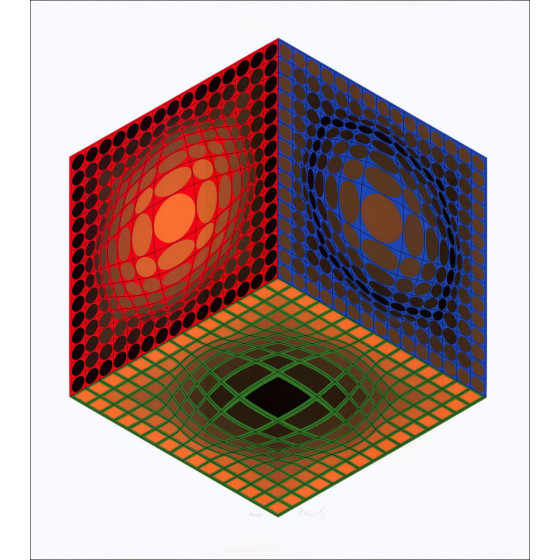
- Out of stock
Victor Vasarely, the Magician Who Made Shapes Move
A checkerboard that swells like a sphere, cubes that seem to advance then retreat, lines that vibrate under the gaze: before a work by Victor Vasarely, the eye no longer knows where to rest. Father of optical art, or op art, this Hungarian graphic artist settled in Paris made visual illusion a full-fledged artistic language. His screenprints, multiples, and architectural integrations made him one of the most popular artists of the 1960s and 1970s.
- 1906: Birth of Győző Vásárhelyi in Pécs, Hungary, on April 9.
- 1929: Student at the Műhely in Budapest, a school inspired by the Bauhaus.
- 1930: Moves to Paris, where he works as an advertising graphic designer.
- 1937: Zèbres, considered one of the first works of optical art.
- 1944: First exhibition at the gallery Denise René, who would support him for life.
- 1955: Exhibition "Le Mouvement" and Yellow Manifesto.
- 1965: Major presence in "The Responsive Eye" exhibition at MoMA, New York.
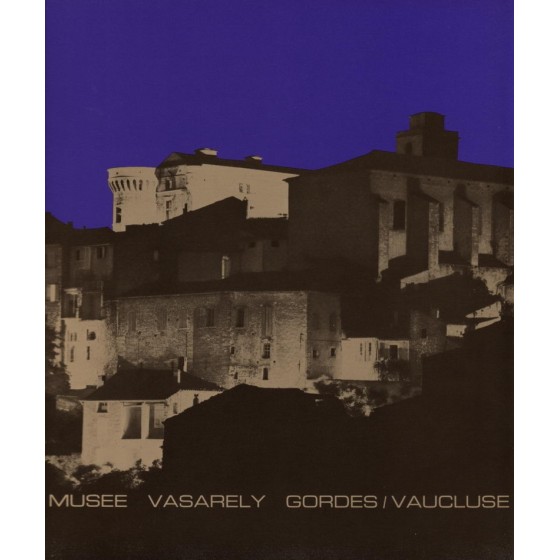
- 1970: Opening of the Vasarely Didactic Museum at the Château de Gordes.
- 1972: New diamond-shaped Renault logo, with his son Yvaral.
- 1976: Inauguration of the Vasarely Foundation in Aix-en-Provence.
- 1997: Death in Paris, on March 15.
From Budapest to Paris
Born in Pécs, Victor Vasarely began medical studies before choosing art. In Budapest, he joined the Műhely, a small school inspired by the Bauhaus, where he discovered abstraction, constructivism, and modern graphic design. Settled in Paris in 1930, he worked for advertising agencies and already explored optical effects, as in his famous Zèbres, where two animals emerge from a simple play of black and white stripes.
The Invention of Optical Art
After the war, Vasarely devoted himself to geometric abstraction. He developed a true plastic alphabet, made of basic units, squares, circles, diamonds, declined in codified color ranges. In 1955, the exhibition "Le Mouvement" at the gallery Denise René, and his Yellow Manifesto laid the foundations of kinetic art. Ten years later, the exhibition "The Responsive Eye" at MoMA in New York established op art worldwide. His Vega series, with deformed spheres, and his compositions from the Planetary Folklore period became emblematic.
An Art for All
Vasarely dreamed of a social, reproducible art, present in the street, architecture, and homes. He multiplied screenprints and multiples, designed facades, murals, and logos, including the diamond of Renault designed in 1972 with his son Yvaral. In 1970, he founded a didactic museum at the Château de Gordes, in the Luberon, then inaugurated in 1976 the Vasarely Foundation in Aix-en-Provence, a building conceived as a work, whose cells house his large mural integrations. The Centre Pompidou dedicated a major retrospective to him in 2019.
Vasarely's Screenprints
Screenprinting, with its perfect flat tints and bold colors, ideally suits his art. Vasarely created many, generally hand-signed in pencil and numbered, sometimes as artist's proof. They reprise his major series and most vibrant compositions.
Choosing a Work by Victor Vasarely
- The signed screenprints from the Vega and Planetary Folklore series offer all the magic of optical illusion.
- The black and white compositions captivate with their graphic precision, while the large colored pieces bring energy and modernity to an interior.
- Books dedicated to his work also allow for further exploration.
- Each work offered by the gallery is precisely described and sold with an invoice-certificate.
Victor Vasarely: Prices and Market Value
Victor Vasarely extensively worked on multiples, true to his idea of art accessible to all, allowing for collection at any budget. The price depends on the nature of the work, signature, edition, format, period, and condition. As an indication, here are the generally observed ranges on the market, in galleries and public sales:
- Posters, cards, and offset reproductions: from a few tens to a few hundred euros.
- Signed and numbered screenprints: from a few hundred to a few thousand euros.
- Multiples and sculptures in plexiglass, wood, or metal: several thousand euros.
- Studies, gouaches, and collages: from several thousand to several tens of thousands of euros.
- Paintings: from several tens of thousands to several hundreds of thousands of euros.
The optical compositions in relief, spheres, zebras, and large colorful works from the 1960s and 1970s are the most sought after. For screenprints, the pencil signature and color freshness greatly influence the price.
What is Op Art?
Op Art, or Optical Art, uses geometric shapes, contrasts, and colors to create illusions of movement, relief, or vibration. Victor Vasarely (1906-1997) is considered its father, starting with his Zèbres from the 1930s.
Did Vasarely Design the Renault Logo?
Yes. In 1972, with his son Yvaral, Vasarely redesigned the brand's famous diamond, with parallel lines creating a relief effect. It is one of the most well-known examples of his ambition: to bring art into everyday life.
Where to See Vasarely's Works?
The Vasarely Foundation in Aix-en-Provence, a building designed by the artist himself, presents his large mural integrations. In Hungary, two museums are dedicated to him, in Pécs, his birthplace, and in Budapest.
What are Vasarely's Most Expensive Works?
They are his large paintings from the 1960s and 1970s. Altaï III exceeded 565,000 pounds at Sotheby's in 2010, and Zèbres 485,000 pounds at Christie's in 2017. His signed screenprints remain accessible to a wide audience.
Victor Vasarely at Galerie 125
The signed screenprints Vega Sakk, Gewa, and Tupa, presented above, have already found buyers. The gallery still offers the Vasarely Museum of Gordes book. New screenprints arrive regularly: check this page, each piece is carefully shipped, with tracked and insured delivery. Other artists of geometric abstraction and movement to discover: Pol Bury, Alexander Calder, and Dan Reisinger.
Do you own a work by Victor Vasarely and wish to sell it? Find out how on our Sell a Work page.