
CALDER Alexander
Alexander Calder (1898-1976), the inventor of the mobile, brought movement into sculpture. Discover below his original lithographs featuring colourful spirals, suns and stars, printed for the Maeght gallery, as well as his exhibition posters.


Alexander Calder
The Inventor of the Mobile
An American sculptor, painter and printmaker, Alexander Calder (1898–1976) revolutionised 20th-century sculpture by bringing movement to it. The inventor of the "mobiles", suspended compositions that move at the slightest breath of air, and of the "stabiles", monumental sculptures standing on the ground, he also created a joyful, colourful graphic body of work, closely tied to France and the Galerie Maeght.
Alexander Calder: Biographical Milestones
1898Born on 22 July in Lawnton, Pennsylvania
1919Graduates as a mechanical engineer
1926Arrives in Paris and creates the "Cirque Calder"
1930Visits Mondrian's studio, a turning point towards abstraction
1931–1932First mobiles, so named by Marcel Duchamp
1950The Galerie Maeght exhibits his work in Paris
1953Settles in Saché, in the Touraine region
1976Dies in New York; retrospective at the Whitney Museum
The Career of Alexander Calder
A Family of Artists and an Engineer
The son and grandson of sculptors, and the son of a painter, Alexander Calder grew up surrounded by studios. As a child, he was already making toys and jewellery from wire. He nevertheless trained as a mechanical engineer, then worked at various jobs before enrolling at the Art Students League in New York, where he studied painting and illustration.
The Calder Circus and Wire Portraits in Paris
In 1926, Calder settled in Paris. There he made a miniature circus out of wire, wood and fabric, complete with acrobats, clowns, animal tamers and animals, which he animated himself before the artistic elite of Paris: Jean Cocteau, Joan Miró, Fernand Léger and Le Corbusier all attended his performances. He also invented wire portraits, true "drawings in space", which brought him his first fame.
Mobiles and Stabiles
In 1930, a visit to the studio of Piet Mondrian, its walls covered with coloured rectangles, sparked a revelation: Calder wanted to make "Mondrians move". He first created motorised abstract sculptures, then, from 1932, suspended compositions set in motion by air, which Marcel Duchamp named "mobiles". Jean Arp, by contrast, named Calder's immobile sculptures "stabiles". Organic forms cut from sheet metal, primary colours, black and white: his visual language was born. A close friend of Joan Miró, he shared with him a taste for free forms and vivid colours.
France, Saché and the Fondation Maeght
Calder divided his life between the United States and France, where he settled permanently in 1953. His monumental stabiles adorn public squares around the world, from La Défense to Chicago, from Montreal to Mexico City. The Galerie Maeght published a large part of his graphic work, and he took part in the creation of the Fondation Maeght in Saint-Paul-de-Vence.
Lithographed Works and Posters
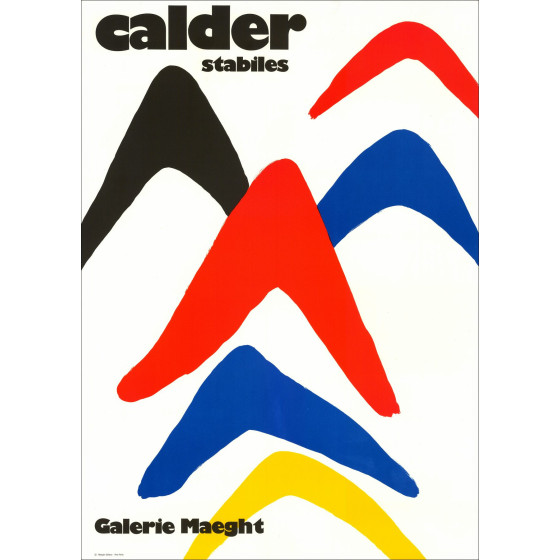
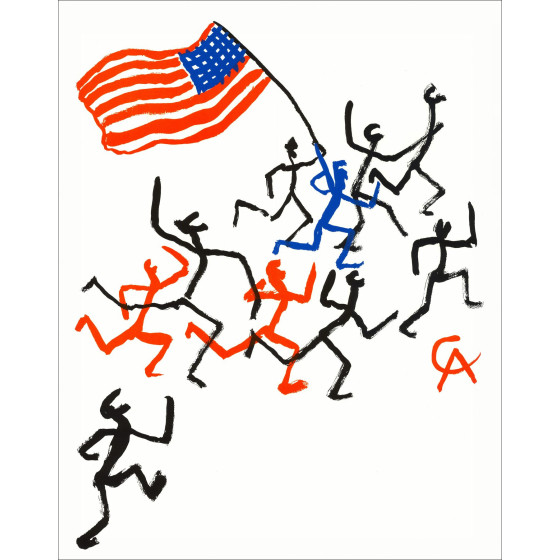
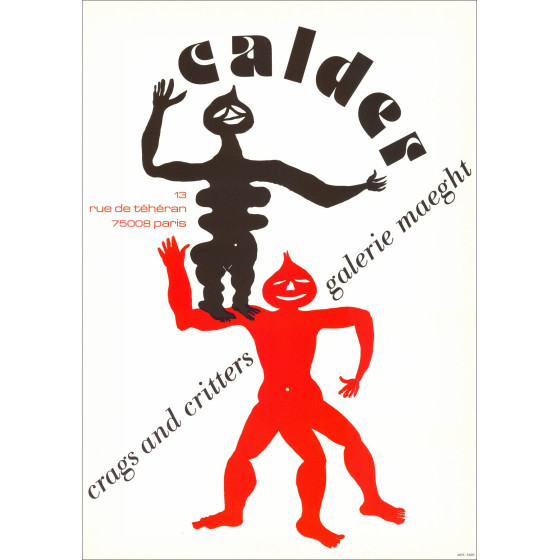
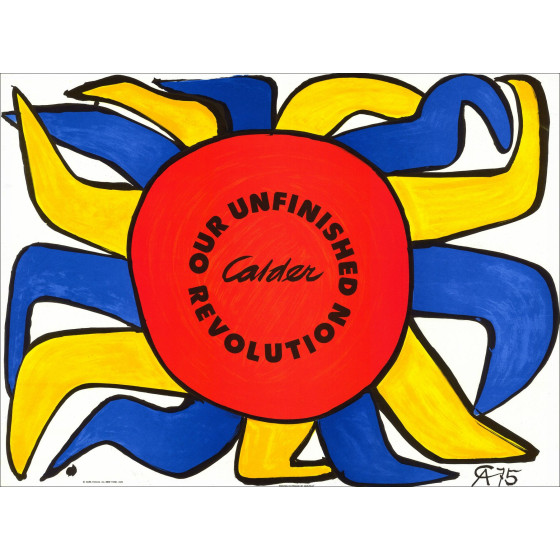
From the 1950s onward, Calder produced a large number of lithographs and gouaches, often published by Maeght and printed by the Arte workshop: spirals, suns, spinning tops, stars, pyramids and balanced forms, in brilliant reds, yellows, blues and blacks. His posters for the Maeght gallery, for exhibitions of his stabiles, or for causes close to his heart, such as Our Unfinished Revolution for the American bicentennial, have become highly sought-after pieces among collectors.
A style instantly recognisable
In Calder's work, the engineer and the poet meet: balance, lightness and the playfulness of childhood can be seen as much in a hanging sculpture as in a lithograph. His primary colours, circles and floating forms sit just as comfortably in a modern interior as in a more classical setting.
Alexander Calder prices and market value: how much is a work worth?
The value of a work depends on the technique, the format, the subject, the condition and the edition. For Calder, the market breaks down as follows:
- Original exhibition posters: from around €95.
- Exhibition lithographs and large-format Maeght lithographs: around €185 to €500, depending on the subject and year.
- Large signed and numbered lithographs: several hundred to a few thousand euros.
- Gouaches, mobiles and stabiles: high market values, reserved for experienced collectors.
An original lithograph is pulled in the workshop from a stone or plate, based on the artist's drawing, on quality paper. It is distinguished from a simple offset reproduction by the fineness of its flat areas and the depth of its colours.
Buy an Alexander Calder artwork
Looking for a Calder lithograph? The gallery currently offers a fine selection of lithographs and posters:
- Our Unfinished Revolution (1976), printed at Mourlot.
- Madison Square Club (1974).
- Exposition Stabiles, Galerie Maeght (1971).
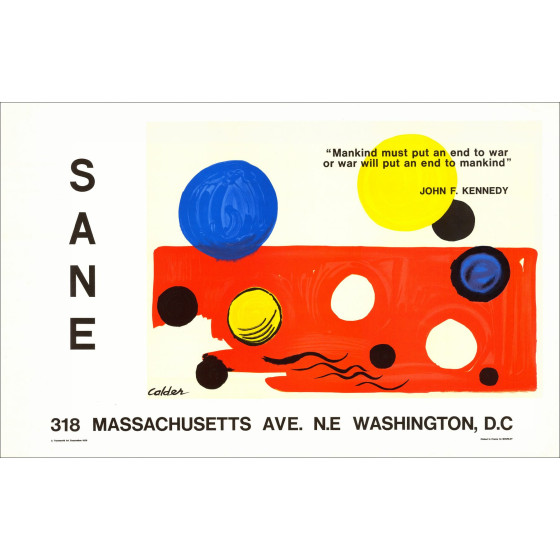
- Exposition Galerie Sane, Washington DC (1965).
- Exposition Galerie Maeght, Paris (1975), from €95.
Asymétrie (1972) has already found a new owner: other pieces arrive regularly, so check the page as new acquisitions are added. Each work is described in detail and sold with a certificate invoice, then shipped promptly, carefully packed, with tracking and insurance. Our art gallery, located near Metz, between Thionville and Luxembourg, also welcomes visitors by appointment: discover the gallery near Metz. You may also like Marc Chagall and Georges Braque, other major names associated with the Maeght family.
Appraisal, sale or purchase of a Calder lithograph
Do you own a lithograph or print signed by Alexander Calder? Galerie 125 offers a confidential, no-obligation appraisal, based on a thorough knowledge of the market. Simply send detailed photographs, the dimensions, the signature, the numbering and the overall condition of the work. Depending on the quality of the piece, a purchase may be considered. Every request is handled with rigour and discretion.
How much does an Alexander Calder lithograph or poster cost?
Calder works currently available at the gallery range from €95 to €350. On the market, expect to pay from €95 for an original exhibition poster, and roughly €185 to €500 for an exhibition or Maeght gallery lithograph. Large signed and numbered lithographs reach several hundred to a few thousand euros.
What is a mobile, and how does it differ from a stabile?
A mobile is a suspended sculpture whose elements, set in motion by the air, constantly rebalance themselves. The stabile, a term coined by Jean Arp, refers instead to a static sculpture placed on the ground.
Did Calder create posters for the Maeght gallery?
Yes. He created numerous posters for exhibitions at the Maeght gallery in Paris, but also for galleries abroad, such as the Sane gallery in Washington, and for personal causes.
What was Calder's relationship with Joan Miró?
The two artists were close friends. They shared a taste for free forms, bold colours and poetic humour, and both worked with the Maeght gallery.
Why did Calder settle in Saché?
In 1953, he made Touraine his main residence in France, while continuing his travels and his monumental commissions in the United States, Europe and Mexico.
Does the gallery buy back Calder lithographs?
Yes. Galerie 125 reviews your signed Alexander Calder lithographs and prints based on photographs, dimensions, signature, numbering and condition, and can make a purchase offer depending on the quality of the piece.
Do you own an original lithograph, gouache or drawing by Alexander Calder and wish to sell it? Find out how to proceed on our Sell a work page.