
TOBIASSE Théo
Exile, Memory, and the Mediterranean: Théo Tobiasse painted a world of women, journeys, and light, with sumptuous color. Discover his lithographs and original works above.


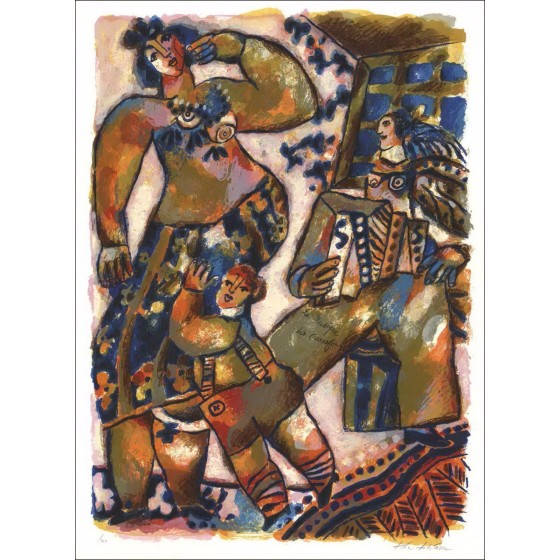
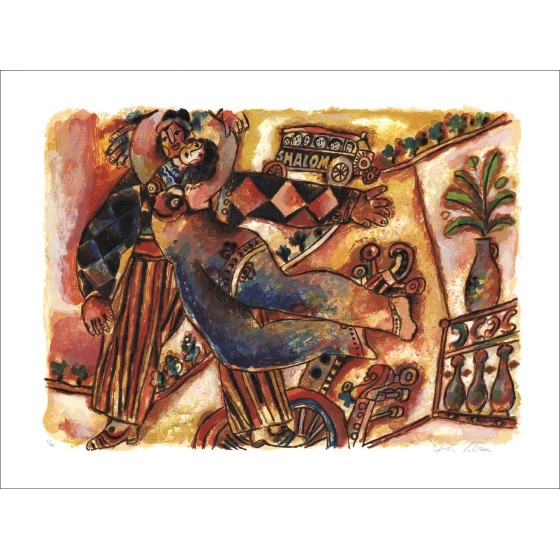
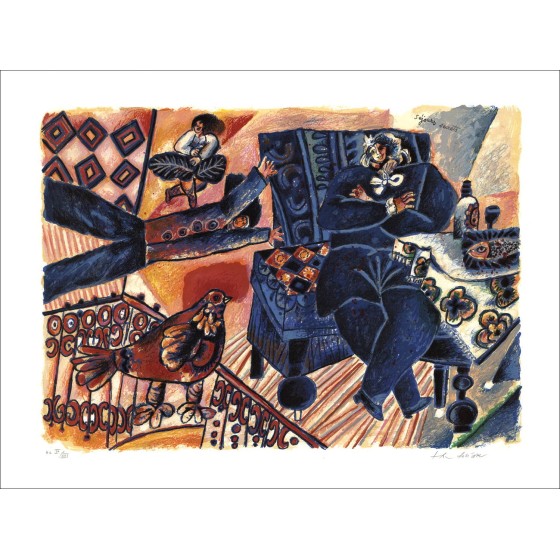
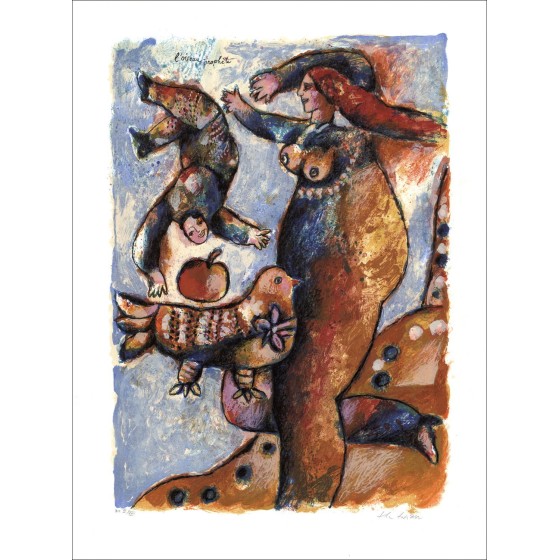
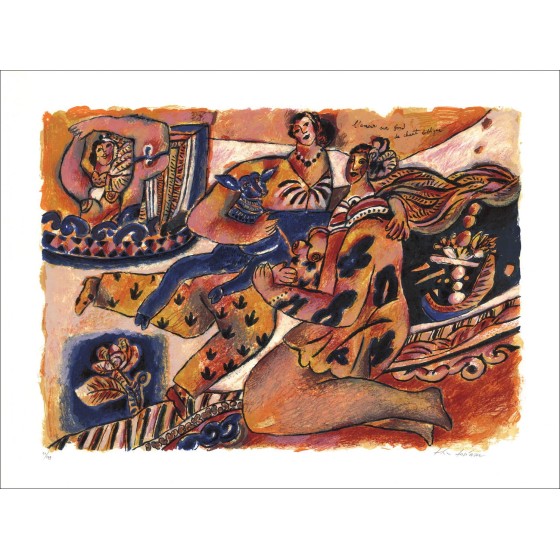

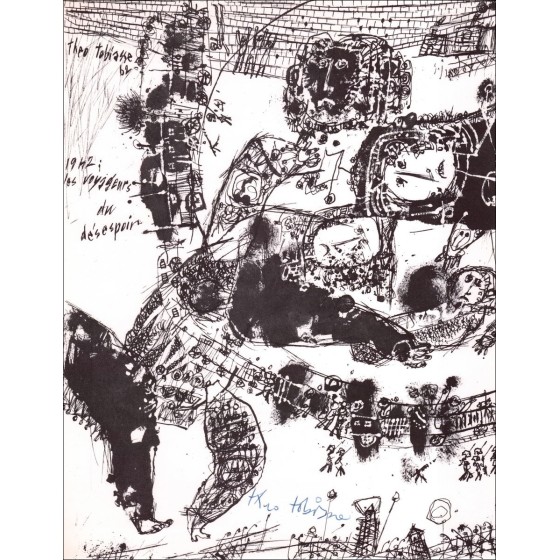
Théo Tobiasse, the hidden child turned painter of memory
In the summer of 1942, a fifteen-year-old boy escapes with his family from the Vél d'Hiv roundup and spends two years confined in a Paris apartment. From this seclusion, Théo Tobiasse retained a lifelong need to tell stories, to paint open windows, trains, women, and dreamed cities. As a painter, sculptor, engraver, and lithographer, he became one of the most endearing figurative colorists of the second half of the 20th century, with a body of work where the Bible, Jewish memory, and poetry intersect.
- 1927: born in Jaffa on April 26, into a Jewish family from Kaunas, Lithuania.
- 1931: the family settles in Paris, where his father works as a typographer.
- 1937: shock in front The Fairy Electricity by Raoul Dufy at the International Exhibition.
- 1942-1944: the family escapes the Vel' d'Hiv roundup and lives in hiding for two years.
- After the Liberation: advertising graphic designer, creator of tapestry cartoons, theater sets, and window displays for Hermès.
- 1950: naturalized French, he settles in Nice.
- 1961: Mediterranean Young Painting Prize and Dorothy-Gould Prize.
- 1962: contract with dealer Armand Drouant and exhibition in Paris.
- 1968: first solo exhibition in New York.
- 1976: main studio in Saint-Paul-de-Vence.
- 2012: died on November 3rd.
From Jaffa to Paris, a Displaced Childhood
His parents, originally from Kaunas, have lived in Jaffa since 1925 when he is born. After a difficult return to Lithuania, the family moves to Paris in 1931. The father finds work in a Russian print shop, and the child grows up surrounded by typefaces, inks, and paper. In 1937, he discovers at the International Exposition the gigantic Fée Électricité of Raoul Dufy, a revelation of color he would often evoke. During the Occupation, the École nationale des arts décoratifs denied his enrollment. He attended a few months of commercial art courses before the threat of raids forced the family into hiding until Liberation.
From Advertising to Painting
After the war, Tobiasse applied his talent to advertising. He worked for the art printer Draeger, designed tapestry cartoons and theater sets, and created window displays for Hermès on Rue du Faubourg-Saint-Honoré. In 1950, he obtained French nationality and settled in Nice, where he initially continued his career as a graphic designer. Gradually, painting took precedence. In 1960, he exhibited his first canvases at the Salon des peintres du Sud-Est. The following year, two awards recognized his work, and dealer Armand Drouant offered him a contract and exhibited his work in Paris in 1962. New York welcomed him in 1968. A trip to Jerusalem in 1970 brought him closer to his roots.
A biblical, poetic, and colorful universe
Sarah, Rachel and Rebecca, the Song of Songs, the prophets, musicians, cities, windows, and the trains of exile: Tobiasse paints a memory both intimate and collective. His compositions blend fragments of writing, collages, and textural effects, like the pages of a travel journal. He begins with oil and gouache. From 1986, he incorporates acrylics, oil pastels, and cut and painted wood or metal panels. He also works in bronze sculpture, ceramics, and stained glass. He is credited with The Garden of Psalms for the synagogue of Strasbourg (1991) and The Song of the Prophets for the great synagogue of Nice (1993). His taste for storytelling, weightless figures, and vibrant colors brings him closer to Marc Chagall, without ever making him an imitator.
The Lithographer and the Engraver
Printmaking holds a major place in his work. In Saint-Paul-de-Vence, he developed lithographs with lithographer Pierre Chave, featuring eighteen to twenty colors, with a rare depth for the technique. He also embraced carborundum engraving, developed by Henri Goetz: the silicon carbide powder creates a velvety relief and intense blacks on the paper, as seen in the suite Let My People Go (1981). His prints are generally hand-signed in pencil and numbered, sometimes justified Artist's proof.
Choosing a Work by Théo Tobiasse
- The large color lithographs showcase the full generosity of his palette and easily find their place in a living room.
- Large-format carborundum prints captivate with their texture and presence.
- The plates of the Cantique des cantiques allow entry into his universe with a more intimate format.
- The choice is first made by a heart's desire, for a theme, a figure, or a harmony of colors.
- Each artwork offered by the gallery is precisely described and sold with an invoice-certificate.
Théo Tobiasse: prices and value of artworks
Théo Tobiasse extensively explored printmaking, in lithography and carborundum engraving, allowing entry into his world at varied budgets. The price depends on the nature of the work, the signature, the edition, the format, the subject, and the condition. As an indication, here are the generally observed ranges on the market, both in galleries and public sales:
- Signed and numbered lithographs: approximately €300 to €1,300, depending on size and number of colors.
- Large carborundum prints: often over €1,000.
- Pastels, gouaches, mixed media: several thousand euros.
- Paintings: from several thousand to several tens of thousands of euros.
Female figures, biblical themes, musicians, windows, and exile trains are the most sought-after subjects. A hand-signed signature in pencil, a limited edition, and well-preserved colors make the difference.
How much is a lithograph by Théo Tobiasse worth ?
Most of his signed and numbered lithographs range from approximately €300 to €1,300. Large formats, biblical subjects, and proofs with many colors are at the higher end.
Théo Tobiasse at Galerie 125
The gallery above presents a collection of signed original prints. Among them, the two large carborundum engravings Rachel and Sarah, , Colombine and Pantalone (1990), and three plates from the Cantique des cantiques. Added to these are the large lithographs Family Portrait in Galilee, , Windows of Love, Infinite Labyrinths, , Majestic Pleasures, , The Music of Crossroads, , Street Dance, , Secret Stays, , The Prophet Bird and Love on a Background of Biblical Chant. . Rebecca and the small lithograph from 1963 The Travelers of Despair have already found buyers. Each print is shipped promptly, with careful packaging, tracked and insured delivery, and the gallery's certificate. You can also view them by appointment in our gallery near Metz, less than two hours from Strasbourg's stained glass. In the same spirit, discover the works of Marc Chagall, , Mané-Katz and Joseph Pressmane. Also discover our selection of lithographs and etchings.
Do you own a work by Théo Tobiasse and wish to sell it? Learn how on our page Sell an artwork.