
BABOULÈNE Eugène
Eugène Baboulène (1905-1994), painter and lithographer born in Toulon, made Provençal light the heart of his work. His pastel harmonies and loose brushwork, often compared to those of Bonnard, earned him the description "the most dreamy of the figurative painters". Galerie 125 offers a selection of his original lithographs signed in pencil, including several plates from the suite La Provence, to discover below.



Eugène Baboulène
The dreamy painter of Provence
Born in Toulon in 1905 and dying in the same city in 1994, Eugène Baboulène looked at the South of France with a gentleness that is as much about memory as observation. A figure of the contemporary Provençal School, this figurative painter was described by critic André Salmon as "the most dreamy of the figurative painters". His canvases and his original lithographs both confirm this.
Eugène Baboulène, from Toulon to Paris and back
Trained at the École des Beaux-Arts in Toulon, Baboulène continued his studies in Paris, at the École nationale supérieure des beaux-arts and then at the Arts décoratifs. He worked nights as a retoucher for the newspaper L'Intransigeant and crossed paths with Derain, Marquet and Kisling. Returning to Toulon in 1931, he became a decorator, notably for the city's theatre, and from 1936 taught decoration at the Beaux-Arts.
In 1946, his encounter with Antoni Clavé and Antoni Tàpies led him to devote himself to painting. He went on to win the Othon-Friesz Prize (1952), the Esso Prize (1955) and the Grand Prix of the Menton Biennale (1957). He exhibited at the Salon d'Automne, in London, Paris, Geneva and New York. His works are held in the Musée d'Art moderne de la Ville de Paris, the Bibliothèque nationale de France, the Musée d'art de Toulon and the Palais Carnolès in Menton.
A tender palette: Baboulène's style, lithographs and subjects
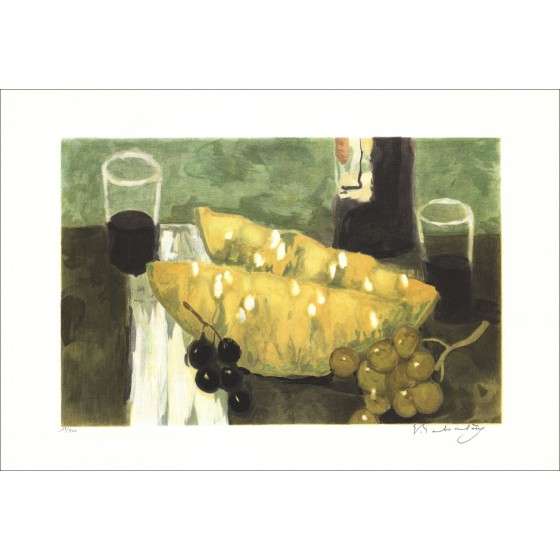
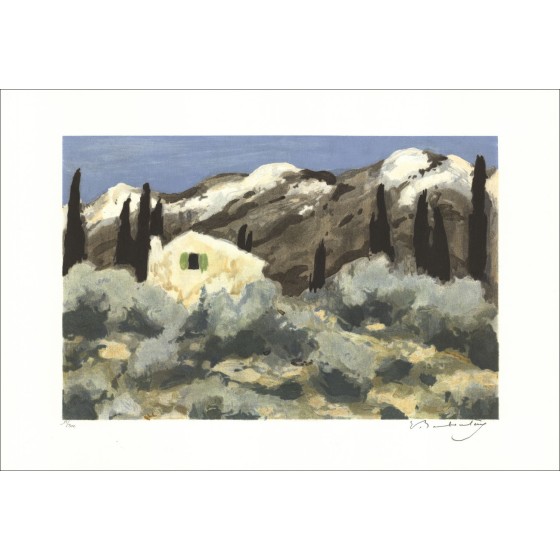
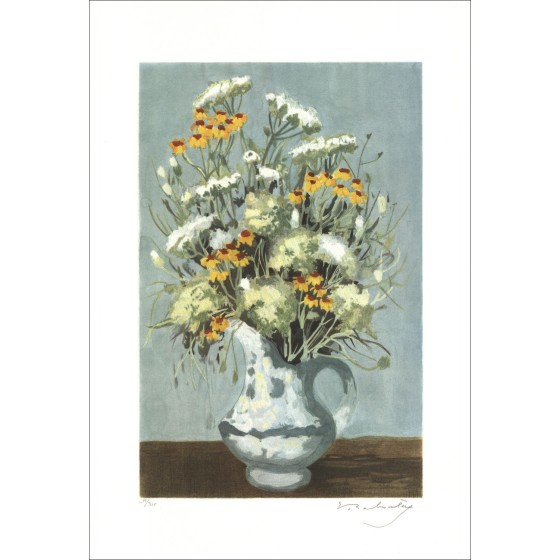
Coloured greys, muted blues, luminous ochres: Baboulène's palette, close to that of Bonnard, lends itself naturally to lithography. His past as a decorator is visible in the breadth of his compositions and in his large areas of flat colour. He preferred simple subjects, transfigured by colour: a melon on a table, wild flowers, a village in Provence.
Published in 1992 by the Éditions méditerranéennes du Prado, the plates of the suite La Provence evoke Canjuers, Eygalières or the grey mountain. The large Bouquet champêtre extends this intimate vein of flowering still life.
Baboulène at Galerie 125
Among the original lithographs signed in pencil currently available, we highlight:
Other plates from the suite will join this page as they are acquired. Each lithograph can be ordered online: it reaches you with the gallery's certificate, carefully packed, tracked and insured. The gallery, in Argancy near Metz, also welcomes you by appointment.
What is special about the lithographs from the suite La Provence?
Published in 1992, they are printed at 38 x 56 cm, in landscape or portrait format. They transpose the painter's landscapes and still lifes into prints.
In which public collections can Baboulène's work be found?
At the Musée d'Art moderne de la Ville de Paris, the Bibliothèque nationale de France, the Musée d'art de Toulon, the Musée Regards de Provence in Marseille and the Palais Carnolès in Menton.
Why is Baboulène described as a "dreamy" painter?
The phrase is André Salmon's. It refers to his pastel harmonies and simple subjects, in which Provence appears as a memory rather than as a postcard.