

Few French artists of the 20thand Few artists of the century experienced such early fame, prolonged disgrace, and clear resurgence as Bernard Buffet. His black, tense, and angular line is unmistakable, both on canvas and paper. Galerie 125 has been seeking, selecting, and presenting his original prints for over twenty years. This guide compiles essential information about the man, his paintings, engravings, and lithographs, answering the most common questions posed by enthusiasts and collectors.
- Bernard Buffet in brief
- A Post-War Prodigy
- The Buffet Style: How to Recognize It
- Painting: The Major Series
- Glory, Purgatory, then Rehabilitation
- Chronology
- From Canvas to Print: Etchings and Lithographs
- Major Themes to Collect
- Painting, drawing, or print: which to choose ?
- Bernard Buffet valuation and price
- Recognize an authentic print
- Glossary of Printmaking
- Buy, appraise, or sell an artwork
- Frequently Asked Questions
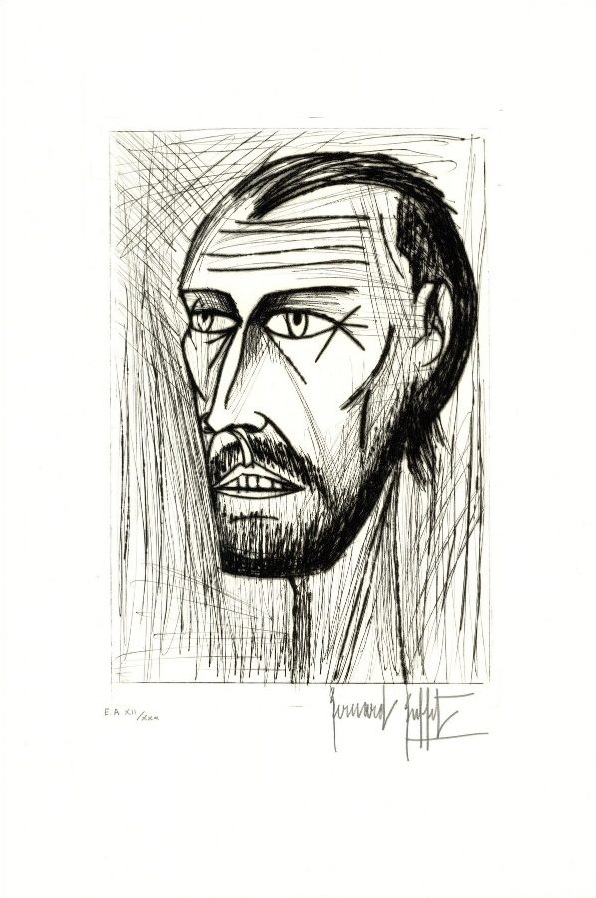
Bernard Buffet, Self-Portrait, 1987. Original engraving on Moulin du Gué paper, Artist's proof hand-signed in pencil. Galerie 125.
Bernard Buffet in brief
| Birth | July 10, 1928, Paris |
|---|---|
| Death | October 4, 1999, Tourtour (Var) |
| Movement | Post-war figuration, leader of "misérabilisme" |
| Techniques | Oil painting, drawing, watercolor, engraving (mainly drypoint), lithography |
| Dealer | Maurice Garnier, from the late 1940s to the artist's death |
| Distinctions | Critics' Prize (1948), Legion of Honor (1971), Academy of Fine Arts (1974) |
| Museums | Museum of Modern Art, Paris, Vatican Museums, Bernard Buffet Museum, Surugadaira (Japan) |
| Print catalogues raisonnés | Maurice Rheims (engraving, 1983); Charles Sorlier (lithograph, volumes I and II, 1979 and 1987) |
A Post-War Prodigy
Bernard Buffet was born on July 10, 1928, in Paris and grew up in the Batignolles district. After attending evening drawing classes in Paris, he was admitted to the École des Beaux-Arts in 1944 at the age of sixteen, thanks to an age waiver. He quickly left to learn from the masters in museums. He exhibited for the first time in 1946, a self-portrait, at the Salon des moins de trente ans.
In 1948, he shares the Critic's Prize with Bernard Lorjou. He is not yet twenty. The dealer Emmanuel David takes an interest in him, followed by Maurice Garnier, who will remain his dealer for half a century. Starting in 1949, every February sees the inauguration of an exhibition of his new works, first at the Drouant-David gallery, then at David and Garnier, and finally at the Maurice Garnier gallery. This annual event, often dedicated to a single theme, punctuates his entire career: Buffet thinks and works in series.
From 1950 to 1958, he shares his life with Pierre Bergé, who helps organize his career. In 1955, a survey by the magazine Knowledge of the Arts ranks him among the leading painters of the young generation. In 1958, at thirty, Galerie Charpentier dedicates a retrospective to him. The same year, he meets Annabel Schwob, whom he marries in December. She will become the most present face in his work and his lifelong companion.
The Buffet Style: How to Recognize It
Often, a single glance is enough to identify a Buffet. Certain constants run through his entire oeuvre, from the first canvas to the last print:
- The Black Line. Each form is outlined by a dark, bold line, structuring the image like a framework.
- Verticality. Stretched silhouettes, elongated faces, spires, skyscrapers, and flower stems: all reach upwards.
- The Angles. Curves are rare. Objects, bodies, and architectures are cut into sharp edges.
- Frontalité. The figures appear front-facing, motionless, often solemn, almost hieratic.
- The signature. Large, angular, integrated into the composition, often accompanied by the date. It is part of the image as much as it authenticates it.
These traits explain why Buffet naturally excelled in printmaking: his art is primarily based on drawing, and engraving as well as lithography lay this drawing bare.
Painting: The Major Series
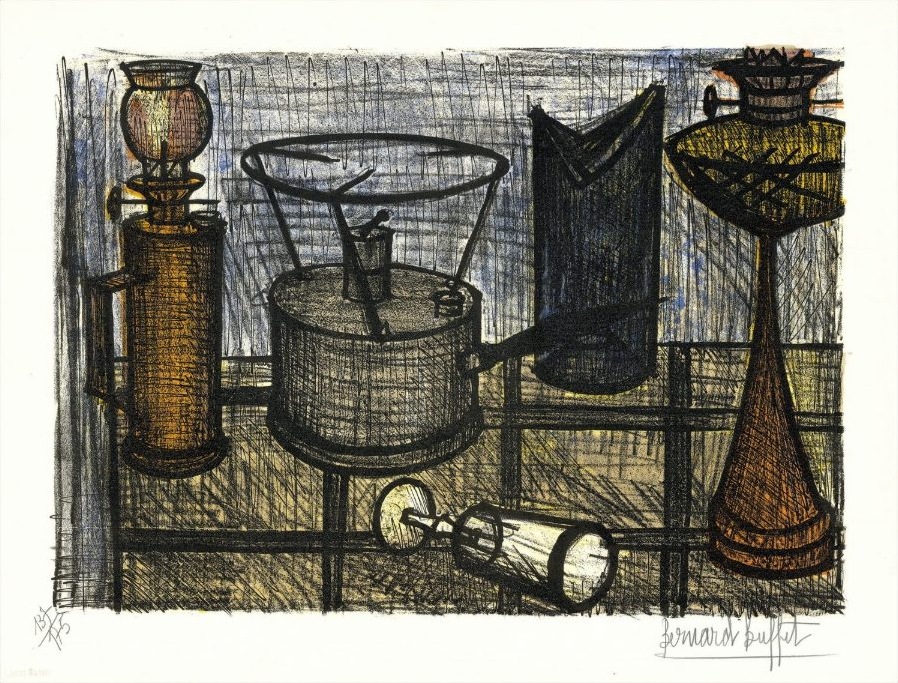
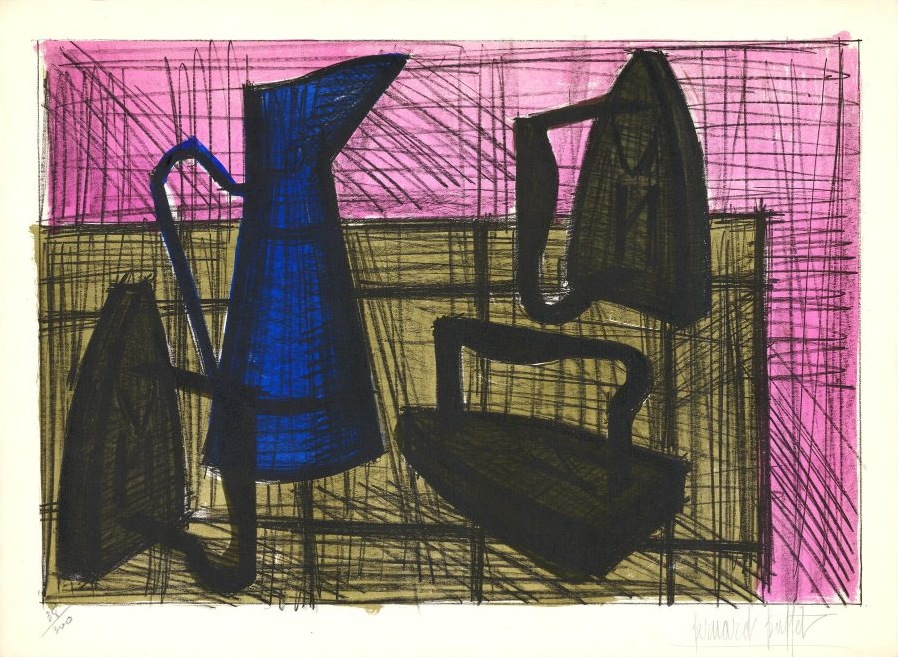
The Grey Years and Miserabilism (1945-1955)
The initial canvases establish an immediately recognizable universe: muted grays, ochres, and browns, with motionless, elongated figures and still lifes reduced to a few humble objects—a lamp, a pan, a bare table. Critics refer to this as "misérabilisme," with Buffet emerging as its leader. It is not a political agenda but a perspective: that of a generation emerging from war, choosing figuration at a time when abstraction dominates galleries. The major cycles of this period are The Passion of Christ (1952) and Horror of War (1954), a triptych accompanied by twenty-six watercolors.
|
Oil Lamp, circa 1954. Original lithograph, numbered and hand-signed in pencil, catalogue raisonné volume I no. 5. |
The Flat Irons, 1955. Original color lithograph, volume I no. 13, published by Guilde de la Gravure, Geneva. |
The Brilliance of Color (1956-1970)
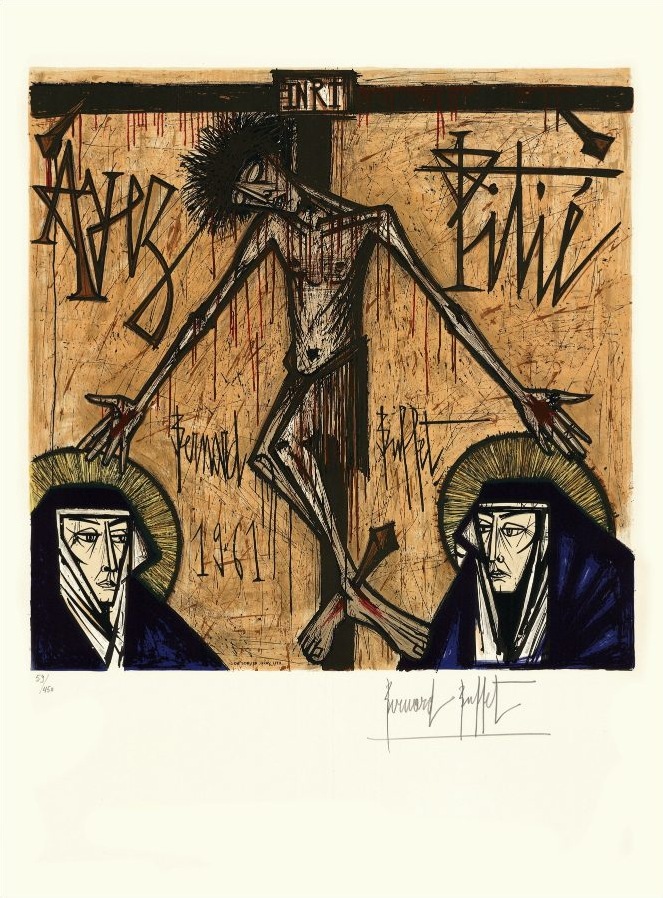
From 1956, the palette brightens and the texture thickens. Then come the Circus (1956), the landscapes of Paris (1957), Joan of Arc (1958), the seven canvases of Birds (1960), then the portraits of Annabel, eighteen of which were exhibited in 1961. That same year, he painted a series on the life of Christ for the chapel of Château de l'Arc, in Provence. These canvases were donated in 1971 to the Vatican Museums, where they are still on display. Following are the Flayed (1965), with thick impasto and drips, the nudes of 1966, then the Bullfight and the Beaches (1967).
|
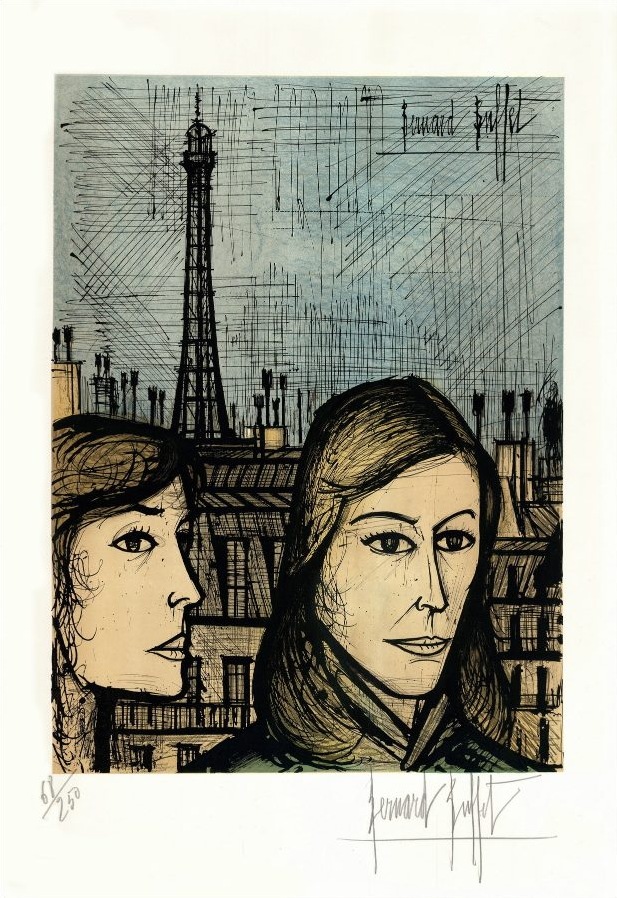
Les Parisiennes, 1958. Original lithograph on BFK Rives wove paper, numbered and signed, catalogue raisonné no. 19. |
Have Mercy, 1961. Original lithograph, numbered and hand-signed in pencil, Sorlier volume I no. 304. |
History, Literature and Travel (1970-1999)
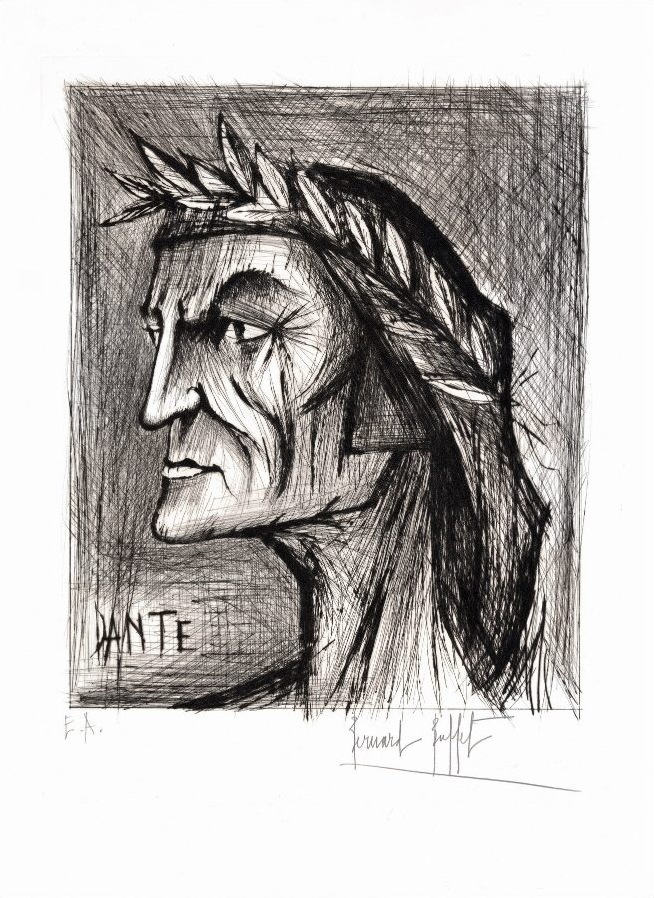
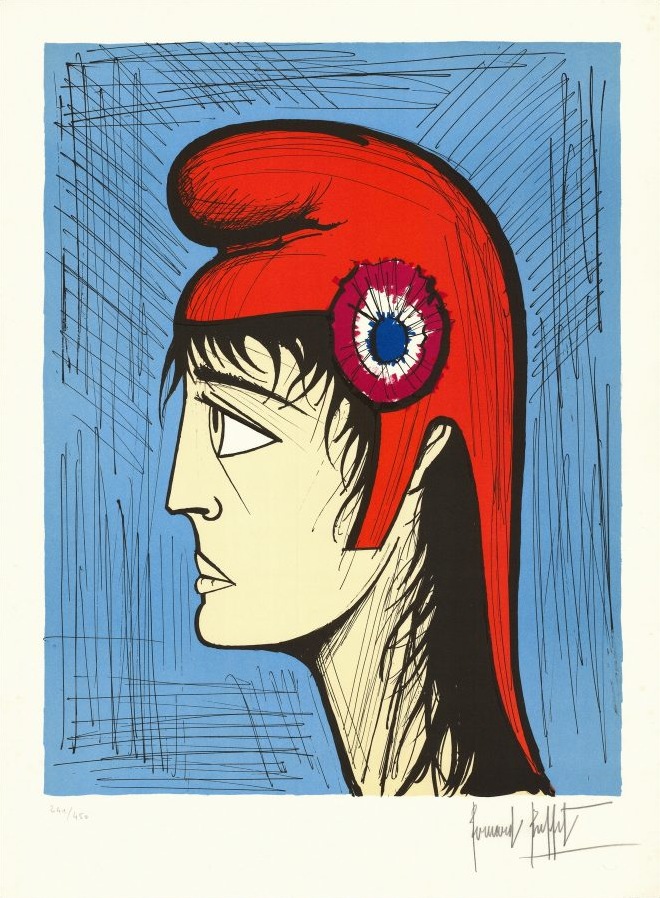
The 1970s are marked by major themes: Les Folles (1971), Dante's Inferno (1977), the French Revolution (1978). Then come the more serene landscapes, followed by the 1981 self-portraits series. His travels inspire new themes: Japan, with the Sumos and the Kabuki (1988), New York, the villages of France and Holland. He also illustrates Twenty Thousand Leagues Under the Sea (1989). Stricken with Parkinson's disease, which gradually prevents him from painting, he passes away on October 4, 1999, in his studio in Tourtour. His final series are titled My Monkeys and The Death.
|
Dante, circa 1976. Original etching, éditions Lacourière-Frélaut, Artist's proof hand-signed in pencil, no. 358 in the print catalog. |
The French Revolution, Marianne. Original lithograph, numbered and hand-signed in pencil. |
Glory, Purgatory, then Rehabilitation
Buffet's commercial success long harmed his critical reputation. The press already dubbed him "the millionaire painter of misery," and part of the art world later criticized his prolific output and commitment to figuration. Yet, official honors were not lacking: knighted in the Légion d'honneur in 1971, he was elected to the Académie des beaux-arts in 1974.
It is in Japan that his work finds its most ardent supporter. In 1973, collector Kiichiro Okano founded the Bernard Buffet Museum in Surugadaira, at the foot of Mount Fuji. This museum, entirely dedicated to the artist, was expanded in 1988, in the presence of Buffet himself.
In France, the turning point was the major retrospective at the Musée d'Art moderne de la Ville de Paris, from October 14, 2016, to February 26, 2017. Curated by Dominique Gagneux, a hundred paintings traced his career. For the public and collectors alike, Buffet regained his place among the great figurative painters of the century.
Chronology
| Year | Event |
|---|---|
| 1928 | Born in Paris, July 10 |
| 1944 | Entered the École des Beaux-Arts at sixteen |
| 1946 | First exhibition, at the Under Thirty Salon |
| 1948 | Critics' Prize, shared with Bernard Lorjou |
| 1949 | First of the annual February exhibitions |
| 1952 | The Passion of Christ |
| 1954 | Horror of War |
| 1956 | The Circus ;the palette brightens |
| 1958 | Retrospective at Galerie Charpentier; marriage with Annabel |
| 1961 | Chapel of Château de l'Arc, portraits of Annabel |
| 1968 | Lithograph Album My Circus |
| 1971 | Legion of Honor; donation of chapel paintings to the Vatican |
| 1973 | Opening of the Bernard Buffet Museum in Japan |
| 1974 | Election to the Academy of Fine Arts |
| 1977-1978 | Dante's Inferno, , The French Revolution |
| 1979 | First volume of the lithograph catalog by Charles Sorlier |
| 1983 | Catalogue of the Engraved Work by Maurice Rheims |
| 1987 | Second volume of the lithography catalog |
| 1989 | Album Don Quixote, printed at Mourlot |
| 1999 | Death in Tourtour, October 4 |
| 2016-2017 | Retrospective at the Musée d'Art Moderne de la Ville de Paris |
From Canvas to Print: Etchings and Lithographs
Buffet's engravings and lithographs are not reproductions of his paintings. They are original works, conceived and drawn by the artist himself, then printed in limited editions under his supervision. However, they closely follow his pictorial themes: those who appreciate his clowns, bouquets, or views of New York will find them in prints, in formats and at prices that are much more accessible.
The print
Buffet engraved from the late 1940s. He primarily worked in drypoint, directly incising the copper with a steel point, without using acid. This technique demands a confident hand and perfectly suits his sharp drawing style. Maurice Rheims' catalog lists 367 drypoints from 1948 to 1980. His later prints are often published by the Lacourière-Frélaut studio and printed on Moulin du Gué paper.
The lithograph
Lithography allows him to work with color and design entire series. Many of his lithographs are printed in Paris at the Mourlot studio, where Charles Sorlier, the studio's lithographer and author of his catalogues raisonnés, accompanies him for decades. The editions are most often produced on Arches or Rives wove paper. Sorlier's two volumes list 515 lithographs from 1952 to 1986.
The albums
Buffet also created lithograph albums, often dedicated to a text or theme: My Circus (1968), Dante's Inferno, or even Don Quixote (1989), to which we dedicated a detailed article : ten original color lithographs with Cervantes' texts calligraphed by the artist. Complete, with its title page, justification, and original case, an album retains a higher value than its dispersed plates.
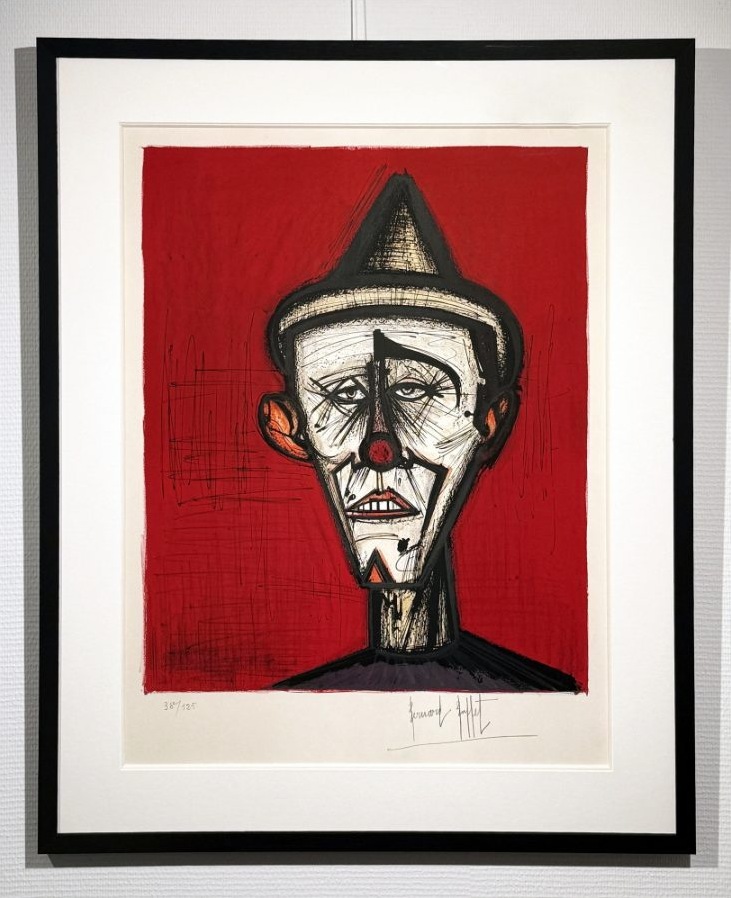
Mon cirque, Clown on Red Background, 1968. Original lithograph, numbered and signed, catalogue raisonné no. 139.
Major Themes to Collect
Buffet's printed work is extensive, offering a thread for each collector. Here are the main ones, with examples presented by Galerie 125.
- The Circus. Clowns have become his emblem. The album My Circus (1968) is the pinnacle: Clown on Red Background, , The Free Hippopotamus.
- Flowers and Still Lifes. Tightly packed bouquets in a vase, outlined in black on vibrant backgrounds: Daisies in a Mazagran, , Daisies and Anemones, , Bouquet of Tulips, , Vanity.
- Paris and New York. Vertical architectures and precise perspectives: Paris, Les Invalides, , Paris, the Moulin Rouge, , New York, Lenox Avenue, , New York, Pan Am.
- The Villages of France and Holland. Churches, Cafés, and Windmills: Mareuil, the Yellow and Blue Café, , Basilica of Vézelay, , The Three Mills, , Sloten.
- Japan. A mutual passion, evidenced by The Japanese Women and the Temple Ryoan-ji.
- The Automobiles. A more unexpected series, that of collectible cars: Rolls Royce 1937 grey.
- Les femmes et Annabel. Portrait of Annabel, , Head of a Woman, , Les Parisiennes.
- History and literature. The French Revolution (Marianne), Dante and especially Don Quixote, with thecomplete 1989 album with its black suite and individual plates such as Don Quixote in a Cage.
|
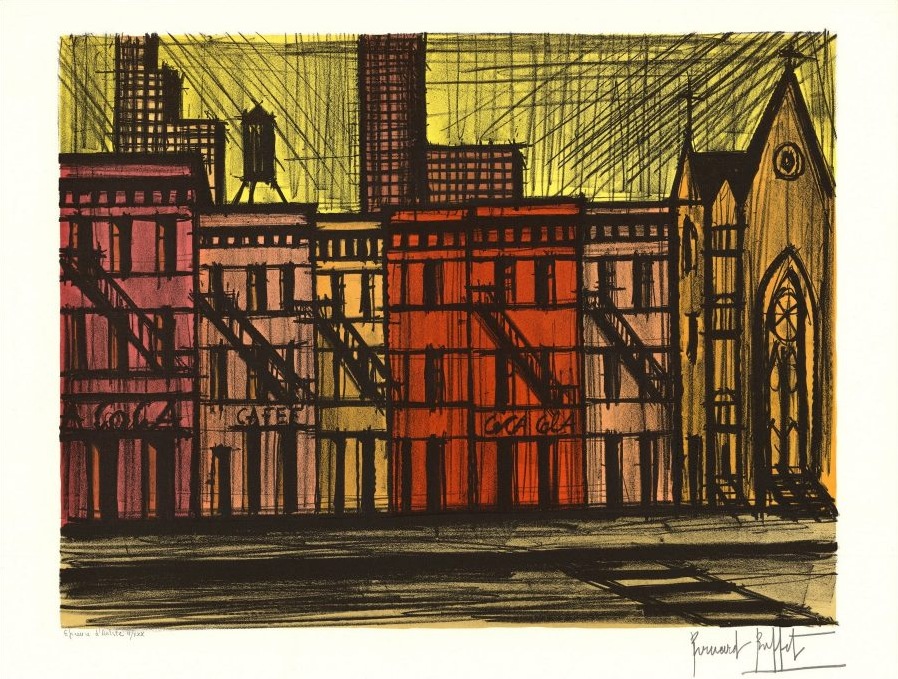
New York, Lenox Avenue, circa 1991. Original lithograph printed at Mourlot, Artist's proof E.A. II/XXX hand-signed in pencil. |
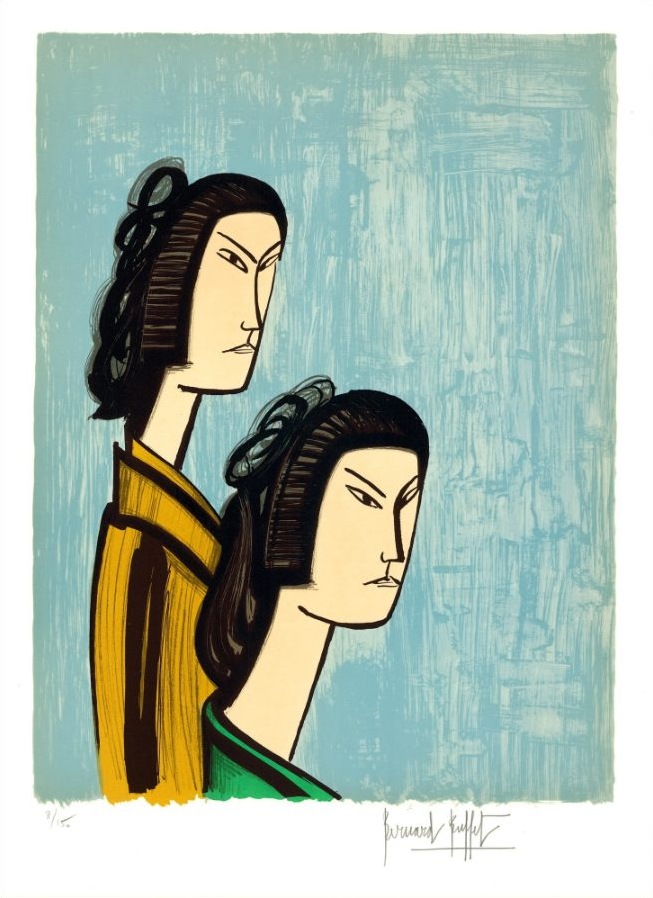
The Japanese Women, 1981. Original lithograph, numbered and hand-signed in pencil, catalogue raisonné no. 354. |
Painting, drawing, or print: which to choose ?
An original work by Bernard Buffet can take three forms, each with a different budget.
| Type of work | What to Know |
|---|---|
| The painting | A unique piece, oil on canvas. Canvases range from tens of thousands of euros to over a million for the most significant ones. Documented provenance and a certificate are essential. |
| Drawing and Watercolor | A unique piece, by the artist's hand, more accessible than a canvas. The ink drawing is the medium where their line expresses itself most freely. Galerie 125 has, for example, presented an original ink drawing, The Sunflowers, signed and dated 1992. |
| The original print | Engraving or lithograph designed by the artist, limited edition, numbered and signed. It is the most natural way to start a collection, ranging from a few hundred to several thousand euros. |
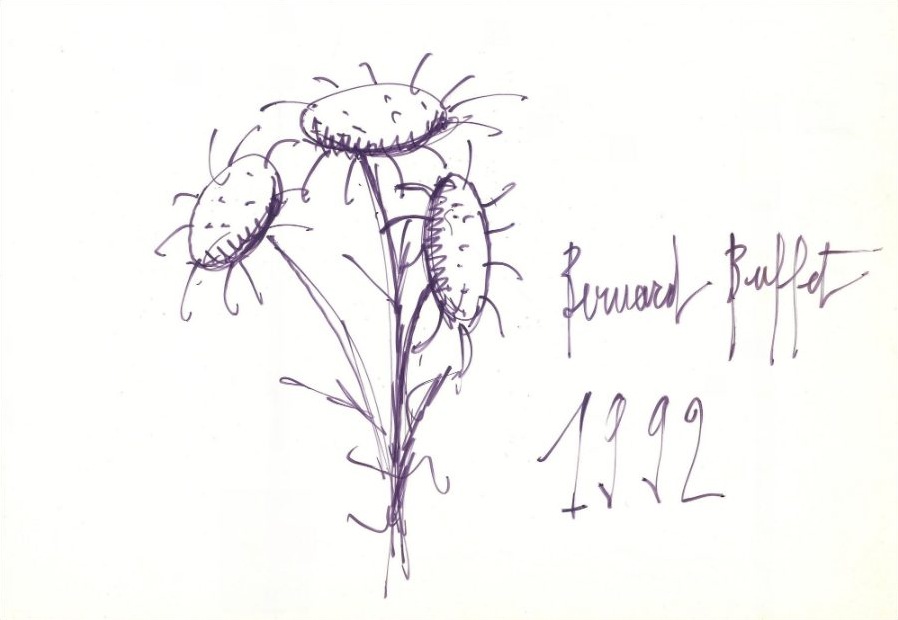
The Sunflowers, 1992. Original ink drawing on paper, signed and dated. Unique work.
Bernard Buffet valuation and price
Bernard Buffet is among the French artists of the 20th century.and century most present on the international market, in Europe, the United States, and Asia. His auction record was set in December 2021 at Christie's in Hong Kong: The Clown Musicians, the Saxophonist and the Accordionist (1991) was auctioned for 13.5 million Hong Kong dollars, approximately 1.5 million euros. It was the first time a canvas by the artist surpassed this threshold.
For prints, prices depend on several criteria:
- The format. The small lithographs from 1967 (31 x 24 cm) are available from 150 to 300 euros, while the large sheets of 76 x 58 cm are usually priced between 1,500 and 3,500 euros.
- The subject. The circus, New York, and large bouquets are the most sought-after themes.
- The justification. A numbered and hand-signed proof is worth significantly more than a proof signed in the plate or an unnumbered proof.
- Exceptional pieces. A lithograph hand-enhanced, like the Torero from 1966 enhanced with graphite, or a complete album like the Don Quixote, are well above.
- The State. A sun-exposed, yellowed, or stained sheet loses significant value.
Recognize an authentic print
Because Buffet is highly sought after, he is also frequently copied. Prior to any purchase, certain verifications are essential.
- The catalogue raisonné. Three reference works: Bernard Buffet engraver by Maurice Rheims (1983), and the two volumes of Bernard Buffet lithograph by Charles Sorlier (1979 and 1987). The lithographs are commonly identified by their Sorlier number. Galerie 125 also offers the first volume of Charles Sorlier's catalog.
- The signature. It may be in pencil, ink, or "in the plate," meaning drawn on the stone and printed with the image. All three are authentic but not equally valued in the market. A printed signature on a reproduction is revealed by its halftone dots under magnification.
- The justification. For Buffet, numbering is the rule. The genuine Artist's proofs are themselves numbered in Roman numerals (for example E.A. II/XXX). A mention " E.A. » without a number requires more caution.
- The paper. Arches, Rives, or Moulin du Gué: thick, matte papers with visible texture. Thin or glossy paper should raise concern.
- The price. A "signed lithograph" offered for a few dozen euros is almost always a reproduction or a poster.
To explore these topics further, the Guide de l'Estampe dedicates a comprehensive dossier to Bernard Buffet engraver and lithographer.
Glossary of Printmaking
For a detailed presentation of the technique, visit our page The Lithograph Explained and our format guide.
- Original print: image printed from a matrix (copper, stone, wood) created by the artist, in a limited edition.
- Drypoint: Intaglio print where the artist directly incises the metal with a steel point. Buffet's preferred technique.
- Lithograph: flat print from a drawing made in pencil or greasy ink on limestone or zinc plate.
- Justification: edition number indicated on the proof, for example 45/120: copy no. 45 from an edition of 120.
- E.A. (Artist's proof) : artist's proof, outside the regular edition. Often numbered in Roman numerals by Buffet.
- H.C. (H.C.): copy intended for the publisher or collaborators, not originally for sale.
- Signed in the plate: signature designed on the matrix and printed with the image, as opposed to the handwritten signature in pencil or ink.
- Plate mark: impression left in the paper by the metal plate of an etching. A lithograph typically does not have one.
- Highlight: artist's manual intervention on a printed proof, creating a unique piece.
- Arches vellum, BFK Rives: Thick, smooth fine art papers used for high-quality editions.
Buy, appraise, or sell an artwork
Purchase a work by Bernard Buffet at Galerie 125
Since 2003, Galerie 125 has showcased original lithographs and etchings of modern, classical, contemporary, and street art. Each print by Bernard Buffet is meticulously detailed (technique, paper, edition, reference to the catalogue raisonné) and comes with a certificate of authenticity from the gallery. Many works are offered framed, with anti-reflective and UV-protective glass.
Do you own a print by Bernard Buffet ? The gallery reviews sales proposals (see our page Sell an artwork). Send us photos of the entire artwork, the signature, the justification, the reverse, and its dimensions, to [email protected], or call 03 87 73 30 94.
Frequently Asked Questions
Who was Bernard Buffet ?
Bernard Buffet (1928-1999) was a French painter, engraver, and lithographer. Revealed at twenty by the Critic's Prize, he is one of the major figures of post-war figurative painting, recognizable by his angular black lines and elongated figures.
What is miserabilism ?
This is the name given by critics in the late 1940s to an austere figurative painting depicting a poor and stripped-down world: bare interiors, modest objects, hollowed faces, muted colors. Buffet is considered the leader, alongside painters such as Bernard Lorjou, André Minaux, and Paul Rebeyrolle.
Why was Bernard Buffet criticized ?
His early success, prolific output, and lifestyle earned him hostility from some critics at a time when abstraction prevailed. His reputation has since been balanced, notably thanks to the retrospective at the Musée d'Art moderne de Paris in 2016-2017.
How much is a lithograph by Bernard Buffet worth ?
A small lithograph from the 1960s ranges from 150 to 300 euros. A large color lithograph, numbered and hand-signed in pencil, typically ranges between 1,500 and 6,000 euros. Complete albums and enhanced proofs reach significantly higher amounts.
How much is a Bernard Buffet painting worth ?
Depending on the format, period, and subject, a canvas can be worth from several tens of thousands of euros to over a million. The current record exceeds 1.5 million euros (Christie's Hong Kong, 2021).
How to verify the authenticity of my Buffet lithograph ?
Examine the signature and numbering with a magnifying glass: a pencil stroke is visible in the paper's texture, a print breaks down into halftone dots. Check the paper, dimensions, and reference in the Charles Sorlier catalog. If in doubt, seek the opinion of a specialized gallery.
What is the difference between an etching and a lithograph ?
The engraving is printed from an incised metal plate: the ink settles in the grooves and the press leaves an indentation in the paper. Lithography is printed flat, from a greasy drawing on stone or zinc. With Buffet, engraving favors black lines, while lithography allows for color.
Does a lithograph signed in the plate have value ?
Yes, if it is a catalogued original lithograph: the signature is then part of the image drawn by the artist. However, its value remains lower than that of a hand-signed proof in pencil or ink.
What is a Bernard Buffet poster ?
The posters announcing his exhibitions (Musée Galliera, Château de Loches, Chenonceau...) are often printed in lithography and are highly decorative. They are neither numbered nor hand-signed and are generally priced between 30 and 300 euros.
Where to see works by Bernard Buffet ?
The Musée d'Art Moderne de la Ville de Paris holds a significant collection of his paintings. The Vatican Museums display the canvases from the chapel of Château de l'Arc. In Japan, the Bernard Buffet Museum in Surugadaira is entirely dedicated to him.
Where to buy a Bernard Buffet artwork with confidence ?
At a specialized gallery, which precisely describes each work, provides its catalogue raisonné reference, and supplies a certificate of authenticity. This is the case with Galerie 125, which permanently presents a selection of original etchings and lithographs by the artist.